Floristic characterization of the mountain rain-forest in the Ecological Reservation El Gigante, Sierra Maestra, Guisa, Granma
Article Sidebar
Main Article Content
Abstract
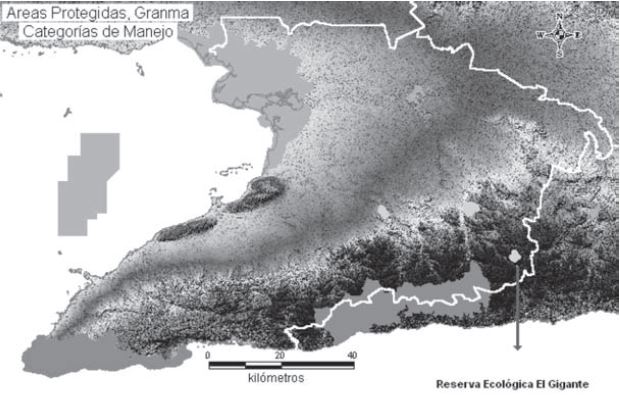
This paper describes a research made at the ecological reservation El Gigante, Sierra Maestra, Cuba, in order to know the floristic composition, geographic distribution and the endemism of the mountain rainforest elements (most extensive formation in the area). For the creation of the floristic list several collections were made, herborization and consultations to specialists on different botanical families. A total of 192 flowering plants species were recorded. For El Gigante, new reports are Begonia alcarrasica and Tabebuia turquinensis; besides that, in the area were found two samples of Caesalpinia bonduc; from the species recorded, 52 (27 %) are neotropical and 27 (14 %) are Caribbean, among the macroantillian, Viburnum villosum and Hibiscus elatus are native of Cuba and Jamaica; 30 % of this ecological reservation is endemic
Downloads
Article Details

This work is licensed under a Creative Commons Attribution-NonCommercial 4.0 International License.
Those authors who have publications with this journal accept the following terms of the License Attribution-NonCommercial 4.0 International (CC BY-NC 4.0):
You are free to:
- Share — copy and redistribute the material in any medium or format
- Adapt — remix, transform, and build upon the material
The licensor cannot revoke these freedoms as long as you follow the license terms.
Under the following terms:
- Attribution — You must give appropriate credit, provide a link to the license, and indicate if changes were made. You may do so in any reasonable manner, but not in any way that suggests the licensor endorses you or your use.
- NonCommercial — You may not use the material for commercial purposes.
- No additional restrictions — You may not apply legal terms or technological measures that legally restrict others from doing anything the license permits.
The journal is not responsible for the opinions and concepts expressed in the works, they are the sole responsibility of the authors. The Editor, with the assistance of the Editorial Committee, reserves the right to suggest or request advisable or necessary modifications. They are accepted to publish original scientific papers, research results of interest that have not been published or sent to another journal for the same purpose.
The mention of trademarks of equipment, instruments or specific materials is for identification purposes, and there is no promotional commitment in relation to them, neither by the authors nor by the publisher.
How to Cite
References
Acevedo-Rodríguez, P., Strong, M.T. 2012. Catalogue of Seed Plant of the West Indies. Smithsonian Contributions to Botany 98. Washington DC. Smithsonian Intitution Scholarly Press. Washington DC.
Berazaín, R. 1979. Fitogeografía. Ciudad de La Habana. Editorial Universidad. 313 p.
------------ 2006. Comentarios sobre los géneros endémicos cubanos. Revista del Jardín Botánico Nacional (CU) 27: 23-31.
Capote y Berazaín. 1984. Clasificación de las formaciones vegetales de Cuba. Cuba. Jardín Botánico Nacional. 49 p.
Gutiérrez A., J. 2002. Flora de la República de Cuba. Familia Sapotaceae. Serie A, Plantas Vasculares, Fascículo 6 (4). Koeltz Scientific Books. 61453 Köeningstein/ Federal Republic of Germany. 8-19 p.
Iturralde-Vinent, M.A. 2006. La paleogeografía del Caribe y sus implicaciones para la biogeografía histórica. Revista Jardín Botánico Nacional (CU) XXV-XXVI: 49-78.
International Plant Names Index 2005. from http://www.ipni.org/ ik_blurb.html
Oviedo R., P. y col. 2012. Lista Nacional de Especies de Plantas invasoras y potencialmente invasoras en la República de Cuba – 2011. Bissea 6 (NE 1). El Boletín sobre Conservación de plantas del Jardín Botánico Nacional de Cuba. p. 22-96
León, Hno. 1946. Flora de Cuba. Vol. I. Contr. Ocas. Museo Historia Natural Colegio la Salle. La Habana. 441 p.
León, Hno. & Hno. Alain. 1951. Flora de Cuba II. Contr. Ocas. Museo Historia Natural Colegio la Salle. La Habana. 456 p.
León, Hno. & Hno. Alain. 1953. Flora de Cuba III. Contr. Ocas. Museo Historia Natural. Colegio la Salle. La Habana. 502 p.
León, Hno. & Hno. Alain. 1957. Flora de Cuba IV. Contr. Ocas. Museo Historia Natural Colegio la Salle. La Habana. 556 pp.