Abarema maestrensis (Urb.) Bässler population structure, a threatened species of the Sierra Maestra
Article Sidebar
Main Article Content
Abstract
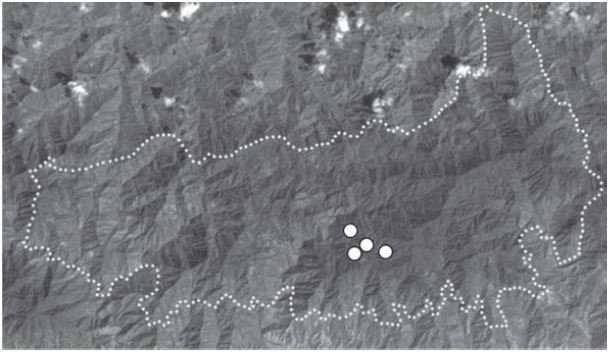
The investigation was developed in the Park National Pick La Bayamesa with the objective to determine the population structure of the specie Abarema maestrensis (Urb.) Bässler. It started from the prospecting of populations and individuals, identifying four scattered sub populations, grouped in isolated patches, from 920 msnm, starting from 920 msnm, the total of individuals reaches 26, for the taxon. A monitoring to the populations sample an appropriate conservation state for the same ones, endorsed by the vertical and horizontal structure, that which denotes the existence of a good natural regeneration of the specie and the perpetuity in the town. The state fitosanitary is satisfactory and reflective the capacity of adaptation of the specie to the existent environmental conditions in the territory.
Downloads
Article Details

This work is licensed under a Creative Commons Attribution-NonCommercial 4.0 International License.
Those authors who have publications with this journal accept the following terms of the License Attribution-NonCommercial 4.0 International (CC BY-NC 4.0):
You are free to:
- Share — copy and redistribute the material in any medium or format
- Adapt — remix, transform, and build upon the material
The licensor cannot revoke these freedoms as long as you follow the license terms.
Under the following terms:
- Attribution — You must give appropriate credit, provide a link to the license, and indicate if changes were made. You may do so in any reasonable manner, but not in any way that suggests the licensor endorses you or your use.
- NonCommercial — You may not use the material for commercial purposes.
- No additional restrictions — You may not apply legal terms or technological measures that legally restrict others from doing anything the license permits.
The journal is not responsible for the opinions and concepts expressed in the works, they are the sole responsibility of the authors. The Editor, with the assistance of the Editorial Committee, reserves the right to suggest or request advisable or necessary modifications. They are accepted to publish original scientific papers, research results of interest that have not been published or sent to another journal for the same purpose.
The mention of trademarks of equipment, instruments or specific materials is for identification purposes, and there is no promotional commitment in relation to them, neither by the authors nor by the publisher.
How to Cite
References
Bässler, M. 1998. Flora de la República de Cuba: Fascículo 2 Mimosaceae. Serie A. Plantas Vasculares. Koeltz Scientific Books. Koenigstein. República Federal de Alemania. 202 pp.
Berazaín, R.; F. Areces; J.C. Lazcano; L.R. González. 2005. Lista Roja de la Flora Vascular Cubana. Documentos del Jardín Botánico Atlántico (Gijón) 4: 1-86.
Budowski, G. 1965. «Distribution of tropical American rain forest in the light of successional processes». Turrialba 15: 40-42.
Caldato, S.L.; Longhi, S.J.; Floss, P.A. 1999. «Estrutura populacional de Ocotea porosa (Lauraceae) em uma Floresta Ombrófila Mista, em Caçador, SC». Ciểncia Florestal (BR) 9: 89-101.
García, M.B. 2002. Interés de los estudios demográficos en la conservación. Catalogación de especies amenazadas. 1527. En: Bañares, A. (Ed.): Biología de la conservación de plantas amenazadas. Organismo Autónomo Parques Nacionales. Ministerio del Medio Ambiente. España. 263 pp.
Lazcano, J.C. 2004. Biología poblacional y aspectos ecológicos de Microcycas calocoma (Miq.) A. DC. en la Sierra de la Caoba Viñales. 40 h. Tesis (en opción al Título Académico de Máster en Ciencias. Mención en Botánica). Universidad de la Habana.
Maceira, F.; Fong, D.A.; Alverson, W.S.; Wachter, T. 2005. Cuba: Parque Nacional La Bayamesa. Rapid Biological Inventories Report 13. The Field Museum, Chicago, USA. 243 p.
Martínez, M. 1985. Claros, ciclos vitales de los árboles tropicales y regeneración natural de las selvas altas perennifolias. En: Gómez, A. y S. Del Amo (eds.). Investigaciones sobre la regeneración natural de selvas altas en Veracruz, México, II. Editorial Alambra Mexicana, Xalapa, Veracruz, México. 191-240.
May, T. 2001. «Estructura poblacional y reproducción natural de diez especies de un bosque nublado en República Dominicana». Revista Forestal Centroamericana (CR) 35: 45-49, julio-septiembre.
Meffe, G.K.; Carroll, C.R. 1997. Principles of Conservation Biology. Second Edition, Sinauer Associates, Sunderland, MA, USA. 729 pp.
Montenegro, V. 1991. Atlas de Santiago de Cuba. Academia de Ciencias de Cuba, Santiago de Cuba.
Odum, E.P. 1988. Fundamentos de ecología. Fundación Calouste Gulbenkian. Cuarta edición. Lisboa. 927 pp.
Primack, R., et al. 2001. Fundamentos de Conservación Biológica. Perspectivas latinoamericanas. Fondo de Cultura Económica. México. 797 pp.
Reis, A. et al. 1996. «Demografía de Euterpes edulis Martius (Arecaceae) em uma Floresta Ombrófila Densa Montana, em Blumenau, SC. Sellowia». Itajaí (BR) no. 4-48: 13-45.
Renda, A.; et al. 1981. Estudio sobre las condiciones edafológicas, fisiográficas y agrosilviculturales de la Sierra Maestra, municipio Guisa. Informe inédito. Centro de Investigaciones Forestales. La Habana. Ministerio de la Agricultura. 90 pp.
Sáenz, G., Finegan, B. 2000. «Monitoreo de la regeneración natural con fines de manejo forestal». Manejo Forestal Tropical no 15. CATIE, Turrialba, Costa Rica. 8 pp.
Weaver, P.L. 1992. «An ecological comparison of canopy trees in the montane rain forest of Puerto Rico’s Luquillo Mountains». Caribbean Journal of Science (US) 28: 62-69.