Assessment of the expected impacts of climate change on Integral Enterprise Forest Villa Clara and strategy of adaptation
Article Sidebar
Main Article Content
Abstract
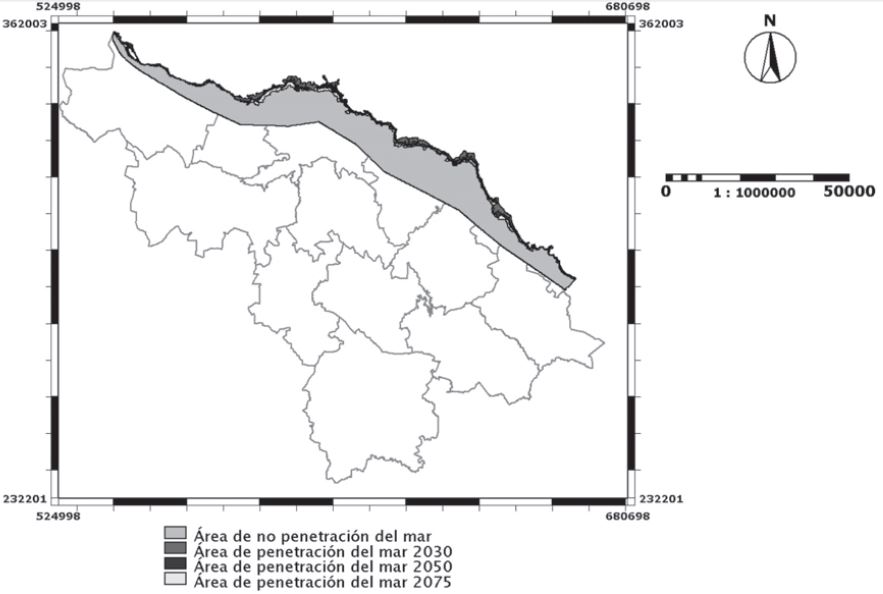
From the A1C scenario for high climate sensitivity (4.2 ° C) the expected impacts that sea level rise would affect forests Integral Forestal Villa Clara from 2030 to 2050 and determined the 2075 the most important impacts are borne in silvicultural units Sagua, Crossroads and Remedios and Avicennia germinans (L.) L. (black mangrove), Laguncularia racemosa (L.) Gaertn. f. (patabán) and Rhizophora mangle L. (red mangrove). Areas Conocarpus erecta L. (yana), Bursera cimaruba L. Sargent (nursery) also affect, but less. Areas affected by the penetration of the sea by forestry units and scenarios 2030, 2050 and 2075 are evaluated; areas of penetration by species and scenarios by species and forestry unit and finally a summary assessment of the areas of penetration of sea species, forestry unit and scenarios, which is used for proposing adaptation strategies which are focused primarily on economic and environmental issues
Downloads
Article Details

This work is licensed under a Creative Commons Attribution-NonCommercial 4.0 International License.
Those authors who have publications with this journal accept the following terms of the License Attribution-NonCommercial 4.0 International (CC BY-NC 4.0):
You are free to:
- Share — copy and redistribute the material in any medium or format
- Adapt — remix, transform, and build upon the material
The licensor cannot revoke these freedoms as long as you follow the license terms.
Under the following terms:
- Attribution — You must give appropriate credit, provide a link to the license, and indicate if changes were made. You may do so in any reasonable manner, but not in any way that suggests the licensor endorses you or your use.
- NonCommercial — You may not use the material for commercial purposes.
- No additional restrictions — You may not apply legal terms or technological measures that legally restrict others from doing anything the license permits.
The journal is not responsible for the opinions and concepts expressed in the works, they are the sole responsibility of the authors. The Editor, with the assistance of the Editorial Committee, reserves the right to suggest or request advisable or necessary modifications. They are accepted to publish original scientific papers, research results of interest that have not been published or sent to another journal for the same purpose.
The mention of trademarks of equipment, instruments or specific materials is for identification purposes, and there is no promotional commitment in relation to them, neither by the authors nor by the publisher.
How to Cite
References
Álvarez, A. et al. 1998. Evaluación general de los posibles impactos del cambio climático sobre los sectores socioeconómicos y ambientales de Cuba. Sector silvícola. Programa de Naciones Unidas para el Medio Ambiente. Programa para la Atmósfera. Subproyecto: «Estudios de casos nacionales para la evaluación de los impactos del cambio climático y las medidas de adaptación». Estudio de Caso: Cuba. Resultados de la Fase I: Evaluación general de los posibles impactos del cambio climático sobre los sectores socioeconómicos y ambientales del país. Instituto Investigaciones Forestales. 14 pp.
Álvarez, A.; Milián, C.; Álvarez, L. 1998. Estudio de caso nacional para la evaluación de los impactos del cambio climático y las medidas de adaptación. Instituto de Investigaciones Forestales. Ciudad de La Habana. 23 pp.
Álvarez, A. 1999. Impactos del Cambio Climático y Medidas de Adaptación en Cuba. Informe Final del Proyecto No.: 01301019 al Programa Nacional de Ciencia y Técnica «Los cambios globales y el Medio Ambiente Cubano». Ciudad de La Habana.
Álvarez, A.; Ponce, D. 2001. El cambio climático y el sector forestal: Segunda aproximación. Reanálisis y regionalización de los impactos del cambio climático. Informe final del Subproyecto 11.25.01. Instituto de Investigaciones Forestales. 43 pp.
Bisse, J. 1988. Árboles de Cuba. Ciudad Habana. Editorial Científico-Técnica. 384 pp.
CITMA. 2011. Resolución 160: Regulaciones para el control y la protección de especies de especial significación para la diversidad biológica en el país. 83 pp.
Empresa Forestal Integral Villa Clara (EFI Villa Clara). 2008. Dinámica forestal. Informe final. EFI Villa Clara. Villa Clara. Cuba.
Hernández, A., Caballero, L. 2004. Estudio de impactos y su adaptación a los efectos de los cambios climáticos por las áreas de la Empresa Forestal Integral Villa Clara. Instituto de Investigaciones Forestales (CD).Taller por el desarrollo Forestal Sostenible DEFORS. 22/09/2005. ISBN.959-246-180-5.
Menéndez, Leda et al., 2000. Bases ecológi cas para la restauración de Manglares en áreas seleccionadas del Archipiélago Cubano y su relación con los cambios globales. Informe al PNCT «Cambios Globales y Medio Ambiente», ACYT, CITMA: 153 pp.