Característics the Dichrostachys cinerea (L.) Wigth et Arm. (marabú) of the production of charcoal
Article Sidebar
Main Article Content
Abstract
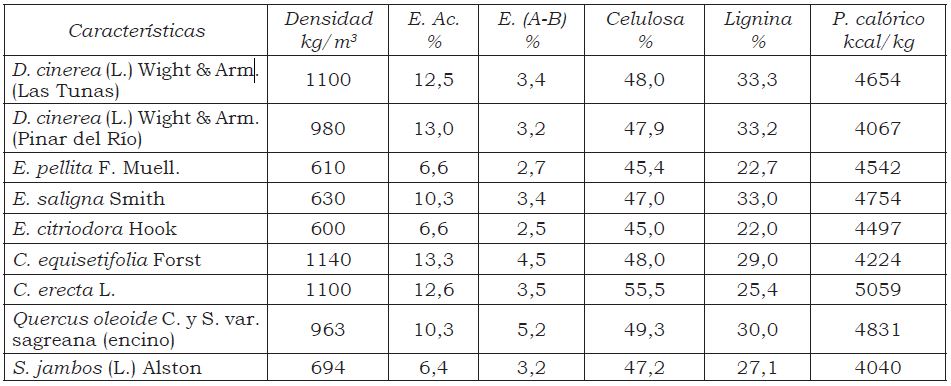
The energy of the biomass constitutes an action line that will allow harmonizing the growth targets, social justness and environmental sustainability. It is carried out an evaluation of the characteristics chemicals of the wood and charcoal of the species Dichrostachys cinerea (L.) Wigth et Arm. (marabú). It was found that of wood presents a high content of extractive in hot water of 12,5-13,0 %, in organic solvents of 3,2-3,4 %, cellulose percentage (48,0 %) and lignin (33 %). The obtained charcoals present among 2-6 % in content of ashy, 64-83 % of fixed carbon, as well as the density above the reported limits. It was observed that the chemical composition of the wood corroborates its excellent energy qualities, a charcoal of quality comparable with other species that they are used in a traditional way for the production of charcoal.
Downloads
Article Details

This work is licensed under a Creative Commons Attribution-NonCommercial 4.0 International License.
Those authors who have publications with this journal accept the following terms of the License Attribution-NonCommercial 4.0 International (CC BY-NC 4.0):
You are free to:
- Share — copy and redistribute the material in any medium or format
- Adapt — remix, transform, and build upon the material
The licensor cannot revoke these freedoms as long as you follow the license terms.
Under the following terms:
- Attribution — You must give appropriate credit, provide a link to the license, and indicate if changes were made. You may do so in any reasonable manner, but not in any way that suggests the licensor endorses you or your use.
- NonCommercial — You may not use the material for commercial purposes.
- No additional restrictions — You may not apply legal terms or technological measures that legally restrict others from doing anything the license permits.
The journal is not responsible for the opinions and concepts expressed in the works, they are the sole responsibility of the authors. The Editor, with the assistance of the Editorial Committee, reserves the right to suggest or request advisable or necessary modifications. They are accepted to publish original scientific papers, research results of interest that have not been published or sent to another journal for the same purpose.
The mention of trademarks of equipment, instruments or specific materials is for identification purposes, and there is no promotional commitment in relation to them, neither by the authors nor by the publisher.
How to Cite
References
Bisse, J. 1988. Árboles de Cuba. Ciudad de La Habana. Editorial Científico-Técnico. 384 pp.
Browning B.L. 1967. Methods of wood Chemestry: T II. Interscience Publishers. A. Diversion of John Welley & Sons. New York. 384 pp.
FAO. 1983. Métodos simples para fabricar carbón vegetal. Roma. FAO. 154 pp.
Guyat, M., Ramos, L., Mercadet, A., Capote, V. 1998. «Potencialidades de especies maderables para energía». Cuba Forestal (CU) 1:8-10.
Guyat, M. 2002. Estudio de dos parámetros en la producción de carbón vegetal a escala de banco. 59 h. Tesis (en opción al Título Académico de Máster en Analisis y Control de Procesos. ISPJAE.
Iglesias, E.V. 1981. La transición hacia un sistema energético múltiple. El Correo de la Unesco. Energía para el siglo XXI. p. 6-8
Manzanares, K. et al. 2008. «Alternativas de manejo de la especie Dichrostachys cinerea (L.) Wight et Arm. (marabú)». Revista Forestal Baracoa (CU) 27(1): 3-12.
NC 580: 2008. Carbón vegetal. Especificaciones. 7 pp.
Patiño, V.F. 1989. La madera como combustible. Primera Reunión Regional sobre Dendroenergía. Memorias. División Ciencias Forestales, Chapingo, México. 440 p.
Pérez Cruz, U.G. 1989. Problemas de abastecimiento y usos de la leña en Tabasco. Primera Reunión Nacional sobre Dendroenergía. División Ciencias Forestales, Chapingo, México, pp. 16-26
Raveendran, K. et al. 1995. «Influence of mineral matter on biomass pyrolysis characteristics 2». Fuel (US) 74 (12): 1813 pp.
Sánchez, R.L. 1998. Celulosa y papel. Universidad Autonóma de Chapingo. 190 pp.
OIMT. 2007. «El papel de la madera como fuente energética del futuro. Conferencia Internacional sobre Dendroenergía». Actualidad Forestal Tropical (JP) 15 (2): 24-25 pp.
Schroeler, T.Y., Hwan O. Ma. 2009. «El uso de la dendroenergía» OIMT. Actualidad Forestal Tropical (JP) 16(3): 12-16.