Conservation state of Pachyanthus pedicellatus Urb. in the Gigante Ecological Reserve
Article Sidebar
Main Article Content
Abstract
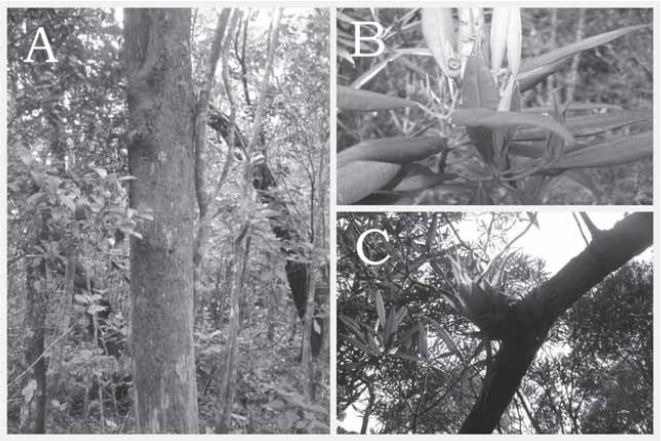
A populational study of Pachyanthus pedicellatus Urb. local endemic specie of the Sierra Maestra is presented. The sampling units as practice settled down, being evaluated the species abundance, reproduction, epifitism and fitosanitary state. A compact population was taken a census of, composed by 24 individuals. The epifitism is in a low grade, being species of the families Bromeliaceae and Orchidaceae the most abundant. The fitosanitary state of the trees is satisfactory, without serious incidences of plagues and illnesses. The specie it show the presence of individuals in the intermediate rank of height keeping in mind their poblational structure. The species fenology shows a delay of the floration and fructification fenophases, of four months for both periods. In a general way the state of conservation of the species is appropriate.
Downloads
Article Details

This work is licensed under a Creative Commons Attribution-NonCommercial 4.0 International License.
Those authors who have publications with this journal accept the following terms of the License Attribution-NonCommercial 4.0 International (CC BY-NC 4.0):
You are free to:
- Share — copy and redistribute the material in any medium or format
- Adapt — remix, transform, and build upon the material
The licensor cannot revoke these freedoms as long as you follow the license terms.
Under the following terms:
- Attribution — You must give appropriate credit, provide a link to the license, and indicate if changes were made. You may do so in any reasonable manner, but not in any way that suggests the licensor endorses you or your use.
- NonCommercial — You may not use the material for commercial purposes.
- No additional restrictions — You may not apply legal terms or technological measures that legally restrict others from doing anything the license permits.
The journal is not responsible for the opinions and concepts expressed in the works, they are the sole responsibility of the authors. The Editor, with the assistance of the Editorial Committee, reserves the right to suggest or request advisable or necessary modifications. They are accepted to publish original scientific papers, research results of interest that have not been published or sent to another journal for the same purpose.
The mention of trademarks of equipment, instruments or specific materials is for identification purposes, and there is no promotional commitment in relation to them, neither by the authors nor by the publisher.
How to Cite
References
Becker, E.: «Estudios taxonómicos en el género Pachyanthus (Miconieae, Melastomataceae) I. Pachyanthus clementis vs Pachyanthus lunanus», Revista del Jardín Botánico Nacional (CU), vol. XXVII-XXVIII, 2006-2007, pp. 39-45.
Berazaín, R.; Areces, F.; Lazcano, J. C.; González, L. R. 2005: «Lista roja de la flora vascular cubana», Revista del Jardín Botánico Atlántico (ES) 4:(1) 86 p.
Bisse, J. 1988: Árboles de Cuba, Ed. Científico-Técnica, La Habana, 384 p.
CITMA, CIDEA. 1995: «Cuba: medio ambiente y desarrollo, La Habana, 12 p.
CITMA, CIGEA. 1999: Situación ambiental cubana 1998, La Habana, 57 p.
García, M. B. 2002: Conservación de especies en Aragón, Madrid, Organismo Autónomo Parques Nacionales, pp. 55 y 56.
Lazcano, J. C.; Leyva, A. T.; Matamoros, Y. 2004: Memorias del III Taller para la Conservación, Análisis y Manejo Planificado de Plantas Silvestres Cubanas, CAMP III, IUCN/SSC, Conservation Breeding Specialist Group, Apple Valley, MN, EE.UU., 320 p.
Lazcano, J. C. 2004: «Biología poblacional y aspectos ecológicos de Microcycas calocoma (Miq.) A. DC., en la Sierra de La Caoba, Viñales», tesis en opción al título de Máster en Ciencias Botánicas, Mención Sistemática en Plantas Superiores, Universidad de La Habana.
May, T. 2001: «Estructura poblacional y reproducción natural de diez especies de un bosque nublado en República Dominicana», Revista Forestal Centroamericana (CR) 35(3), pp. 45-50, jul.-sept.
Renda, A.; Calzadilla, E.; Bouza, J. A.; Arias, J.; Valle, M. 1981: «Estudio sobre las condiciones edafológicas, fisiográficas y agrosilviculturales de la Sierra Maestra, municipio de Guisa», Centro de Investigaciones Forestales, La Habana, 90 p. (inédito).
Santos, W. 2009: «Localidades con alto potencial de especies forestales amenazadas en la Sierra Maestra», IV Encuentro Internacional sobre Desarrollo Forestal Sostenible (Defors), 8 p.