Physical and mechanical characteristic of the wood of five species in Sierra Maestra
Article Sidebar
Main Article Content
Abstract
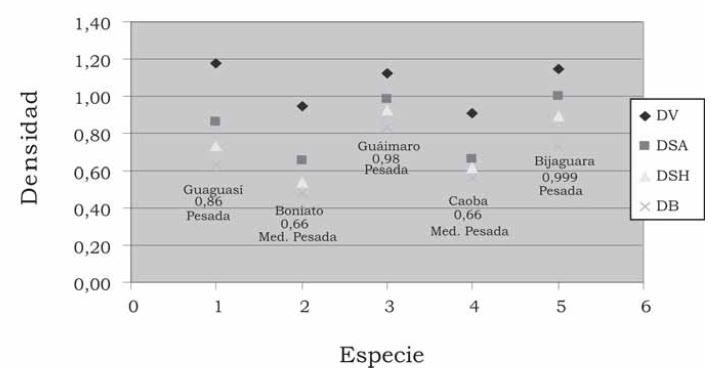
A study is presented on the physical-mechanical property of five species of the Sierra Maestra, which is part of the integral characterization of the same ones. These are: Swietenia mahagoni (L.) Jacq. (antillean mahogany); Brosimun alicastrum (Sw.) Britt. (guáimaro); Cinnamomum parviflorum (Nees) Kosterm. Sweet (potato blanco); Colubrina arborescens (Mill.) Sarg. (bijáguara) and Zuelania guidonia (Sw.) Britt. et. Millsp. (guaguasí). The results of this work demonstrate that the species Colubrina arborescens (Mill.) Sarg. (bijáguara) it presents bigger dry density to the air arriving to 0.999 g/cm3, the remaining securities behaved inferior. The radial tangential relationship behaved favorable in all the cases, except for the guaguasí, where it surpassed 2,2%. As for the mechanical estates the best securities were achieved for the species bijáguara coinciding with the highest value in dry density to the air. The uses in general move from the average carpentry until the lathed objects, standing out among the studied species the Swietenia mahagoni (L.) Jacq. (caoba del país) whose study reaffirms the traditional quality of this important species that he/she inhabits the Cuban forests.
Downloads
Article Details

This work is licensed under a Creative Commons Attribution-NonCommercial 4.0 International License.
Those authors who have publications with this journal accept the following terms of the License Attribution-NonCommercial 4.0 International (CC BY-NC 4.0):
You are free to:
- Share — copy and redistribute the material in any medium or format
- Adapt — remix, transform, and build upon the material
The licensor cannot revoke these freedoms as long as you follow the license terms.
Under the following terms:
- Attribution — You must give appropriate credit, provide a link to the license, and indicate if changes were made. You may do so in any reasonable manner, but not in any way that suggests the licensor endorses you or your use.
- NonCommercial — You may not use the material for commercial purposes.
- No additional restrictions — You may not apply legal terms or technological measures that legally restrict others from doing anything the license permits.
The journal is not responsible for the opinions and concepts expressed in the works, they are the sole responsibility of the authors. The Editor, with the assistance of the Editorial Committee, reserves the right to suggest or request advisable or necessary modifications. They are accepted to publish original scientific papers, research results of interest that have not been published or sent to another journal for the same purpose.
The mention of trademarks of equipment, instruments or specific materials is for identification purposes, and there is no promotional commitment in relation to them, neither by the authors nor by the publisher.
How to Cite
References
Barcenas, G. 1985: «Recomendaciones para el uso de 80 maderas de acuerdo con su estabilidad dimensional», INIREB Nota Técnica 11:1-18.
Carreras, R.: Dechamps, R. 1995: «Anatomía de la madera de 157 especies forestales que crecen en Cuba y sus usos tecnológicos, históricos y culturales», Tervuren. Musee Royal de L´Afrique Céntrale. 2T.
Chuquicaja, J.; Uceda, M. 1989: «Aptitud al laminado de siete especies forestales de la Amazonia Peruana», Revista Forestal del Perú (PE) 11(1) 21-30.
Dickinson, F.; Hess, R.; Wangaard, F. 1949: «Properties and uses of tropical woods, I», Tropical Woods (US) 95:1-145.
Escuza, P.; Trujillo, F. 1989: «Durabilidad natural de cinco especies de la Amazonia Peruana», Revista Forestal del Perú (PE) 11(1) 3-10.
Fors, J. 1965: Maderas cubanas, INRA, Cuba, 182 p.
Hess, R.; Wangaard, F.; Dickinson, F. 1950: «Properties and uses of tropical woods, II», Tropical Woods (US) 97:1-132.
Huerta, J.; Becerra, J. 1976: «Anatomía microscópica y algunas características físicas de diecisiete maderas tropicales mexicanas», Boletín Divulgativo INIF (MX) 46:1-6.
López, A.; López, J. 1990: «Adherencia de pintura al óleo y al látex con y sin imprimante en nueve maderas tropicales del Perú», Revista Forestal del Perú (PE) 12(1): 33-40.
Ibáñez, A.; Manzanares, K.; Sosa, M. 1978: Compendio de 56 especies maderables cubanas, africanas y de otras regiones tropicales, Instituto de Investigaciones Forestales, La Habana, 180 p.
Martínez, J. L.; Martínez-Pinillos, E. 1996: «Características de maquinado de 32 especies de madera», Madera y Bosques (MX) 2(1): 45-62.
NC 43-27:87: «Propiedades físico-mecánicas. Toma de muestras». Vig. abril 1987.
NC-43-31-87: «Determinación de la dureza estática. Janka. Método de ensayo». Vig. noviembre 1987.
NC-43-34-87: «Determinación de la humedad en ensayos físicos-mecánicos». Vig. noviembre 1987.
Serrano, G.; Tournon, J. 1989: «Colorantes vegetales usados por los shipibo-combo en la Amazonia Peruana», Revista Forestal del Perú (PE) 11(2): 75-82.
UNE 56-543-88: «Características físico-mecánicas de la madera: determinación del esfuerzo cortante». Vig. febrero 1988.
Van Der Slooten H. J.; González, M. 1970: Maderas latinoamericanas. V. carapa sp., Virola koschnyi, Terminalia lucida y Brosimun costaricanum», Turrialba (VE) 20(4): 503-510.
Vázquez I. ; Petit, J. 1994: «Caoba. Swietenia macrophylla Kin.», Serie Maderas Comerciales de Venezuela, IFLA (VE) 34:1-44.
Wangaard, F.; Muschler, A. 1952: «Properties and uses of tropical woods, III», Tropical Woods (US) 98:1-193.
Wangaard, F.; Koenler, A.; Muschler, A. 1954: «Properties and uses of tropical woods, IV», Tropical Woods (US) 99:191.