Etnobotánica y propagación de Parmentiera edulis D.C., árbol de uso múltiple en Cuba
Article Sidebar
Main Article Content
Abstract
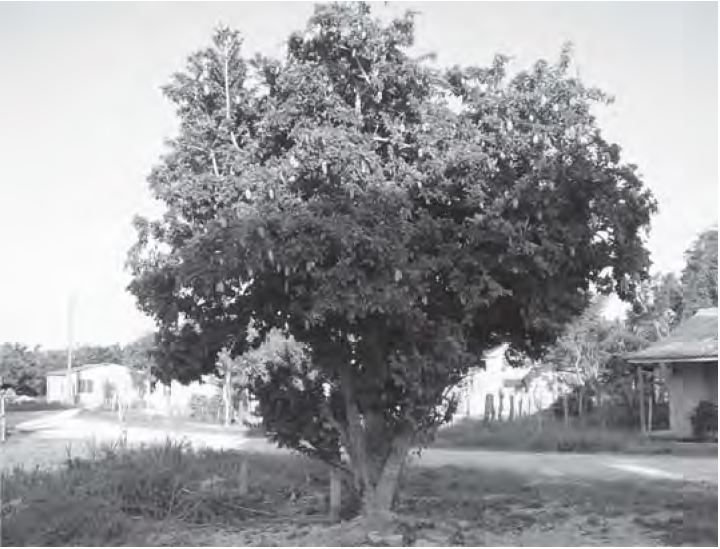
Parmentiera edulis DC it was reported at 20th century in Cuba only by Juan Tomás Roig Mesa in his Dictionary of Cuban Botanical Common Names, with vulgar names Cuajilote and Ají de Cabaiguán. This paper, from Forestry Studies Centre (CEF) at the Pinar del Río University reveals that the species has revealed that is escape of the cultivation in several counties of the country, where people obtain shade, protection and fruits for domestic livestock, Until now, have not been planted for commercial range production. Research has demonstrated that cattle are disperser agent in grasslands. Seed benefits, nursery behaviour and plantations were realized at three different soils. The species was determined as promising for their fruits for daily forage. For these reason, the Forestry Studies Centre will continue research work on this species for introduction in intensive range livestock, at some different conditions of soils and climate in Cuba.
Downloads
Article Details

This work is licensed under a Creative Commons Attribution-NonCommercial 4.0 International License.
Those authors who have publications with this journal accept the following terms of the License Attribution-NonCommercial 4.0 International (CC BY-NC 4.0):
You are free to:
- Share — copy and redistribute the material in any medium or format
- Adapt — remix, transform, and build upon the material
The licensor cannot revoke these freedoms as long as you follow the license terms.
Under the following terms:
- Attribution — You must give appropriate credit, provide a link to the license, and indicate if changes were made. You may do so in any reasonable manner, but not in any way that suggests the licensor endorses you or your use.
- NonCommercial — You may not use the material for commercial purposes.
- No additional restrictions — You may not apply legal terms or technological measures that legally restrict others from doing anything the license permits.
The journal is not responsible for the opinions and concepts expressed in the works, they are the sole responsibility of the authors. The Editor, with the assistance of the Editorial Committee, reserves the right to suggest or request advisable or necessary modifications. They are accepted to publish original scientific papers, research results of interest that have not been published or sent to another journal for the same purpose.
The mention of trademarks of equipment, instruments or specific materials is for identification purposes, and there is no promotional commitment in relation to them, neither by the authors nor by the publisher.
How to Cite
References
Álvarez Olivera, P. A.; E. Calzada Almas; C. O. Batista Cruz: «Algunos elementos para el manejo silvopastoril de Parmentiera edulis D.C., especie forestal de uso múltiple naturalizada en Cuba, Memorias del V Simposio Internacional Forestal Sostenible, Pinar del Río, Cuba, 2008.
Antón Galván, P.: «Caracterización parcial del fruto de Parmentiera edulis», Tesis para el título de Ingeniero en Alimentos, Universidad Tecnológica de la Mixteca, Oaxaca, México.
León, A. L.; J. Poveda: Nombres comunes de las plantas en Costa Rica, Ed. Guayacán, San José, Costa Rica, 2000.
Little, E. L.: Árboles de Puerto Rico y las Islas Vírgenes, vol. II, 1988.
Pinto Ruiz, R.:«Especies arbóreas y arbustivas de uso forrajero en tres regiones de Chiapas», http://www.google.com.cu/search?hl=es&ie =ISO88591&q=Parmentiera+edulis%, 2001 (consulta: 20/04/2007).
Roig Mesa, J. T.: Diccionario botánico de nombres vulgares cubanos, t. I, Ed. Científico-Técnica, La Habana, 1965.
Rodríguez, A.; P. Sánchez: Especies de frutales cultivadas en Cuba para la agricultura urbana, Agrinfor, La Habana, 2001.
Víques, C. M.:Revista Mundo Forestal, San José, Costa Rica, 2004, http://www.elmundoforestal. com/esperanza/1VERDES/cuajilote0.html (consulta: 05/06/2005).