State of the Ecological Reservation «El Gigante»
Article Sidebar
Main Article Content
Abstract
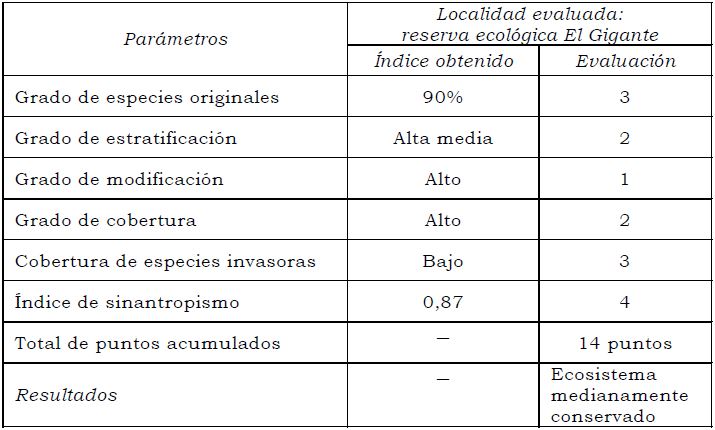
It is carried out an study to determine the state of conservation of the ecological reservation «El Gigante», of the municipality Guisa, Granma province: the index of leaning sinanthropic are used by an instrument that keeps in mind the presence of strata and original species of the vegetation, the modification grade and other wombs that facilitated to determine that this protected area is a fairly preserved ecosystem, which evolves toward a gradual recovery and it has high potentialities for its conservationist use and as natural attractiveness for the nature tourism, with this result they have been able to identify and to locate the main ones you work destructives of the natural resources of area what has facilitated to trace conservation stocks and appropriate handling.
Downloads
Article Details

This work is licensed under a Creative Commons Attribution-NonCommercial 4.0 International License.
Those authors who have publications with this journal accept the following terms of the License Attribution-NonCommercial 4.0 International (CC BY-NC 4.0):
You are free to:
- Share — copy and redistribute the material in any medium or format
- Adapt — remix, transform, and build upon the material
The licensor cannot revoke these freedoms as long as you follow the license terms.
Under the following terms:
- Attribution — You must give appropriate credit, provide a link to the license, and indicate if changes were made. You may do so in any reasonable manner, but not in any way that suggests the licensor endorses you or your use.
- NonCommercial — You may not use the material for commercial purposes.
- No additional restrictions — You may not apply legal terms or technological measures that legally restrict others from doing anything the license permits.
The journal is not responsible for the opinions and concepts expressed in the works, they are the sole responsibility of the authors. The Editor, with the assistance of the Editorial Committee, reserves the right to suggest or request advisable or necessary modifications. They are accepted to publish original scientific papers, research results of interest that have not been published or sent to another journal for the same purpose.
The mention of trademarks of equipment, instruments or specific materials is for identification purposes, and there is no promotional commitment in relation to them, neither by the authors nor by the publisher.
How to Cite
References
Bisse, J. 1988. Árboles de Cuba. Ciudad de La Habana. Editorial Científico-Técnica. 384 p.
Borhidi, A. 1996. Phytogeography and vegetation ecology of Cuba. Budapest. Akadémiai Kiadó, 923 p.
Capote, R. Y Berazain, R. 1984 Clasificación de las formaciones vegetales de Cuba. Revista Jardín Botánico Nacional (CU) 5(2): 27-75.
Fernández, M. 1994. Consideraciones teórico-metodológicas acerca de la evaluación de la cubierta vegetal en el medio ambiente. En su: La Biota, su uso y conservación. Geografía del Medio Ambiente, una alternativa de ordenamiento ecológico. México. Universidad Autónoma de México. p. 96-103.
Matos, M. J. 2006. Manual para el Manejo de Flora Silvestre. Las Villas. Editorial Feijoo. 228 p.
Martínez, Q. 2000. «Flora por áreas naturales». En: Informe Final del Proyecto «Diversidad biológica de los macizos montañoso Sierra Maestra y Nipe-Sagua-Baracoa». Centro Oriental de Ecosistemas y Biodiversidad. p. 79-98.
Ricardo, N.E., Pouyú, E., Herrera, P.P. 1990. Clasificación de la flora sinantrópica de Cuba. Revista Jardín Botánico Nacional (CU) 11 (2-3): 129-133.
Ricardo, N.E., Pouyú, E., Herrera, P.P. 1995. The Synantropic Flora of Cuba. Fontqueria (ES) XLII: 367- 430.