The anthropogenic fragmentation effects at «El Mogote» mountain on the orchids
Article Sidebar
Main Article Content
Abstract
The transformation and uses of the natural resources to satisfy the man’s necessities date from the beginning of the human society. This transformation could cause catastrophic results in the world throughout the years, like the fragmentation of forests.
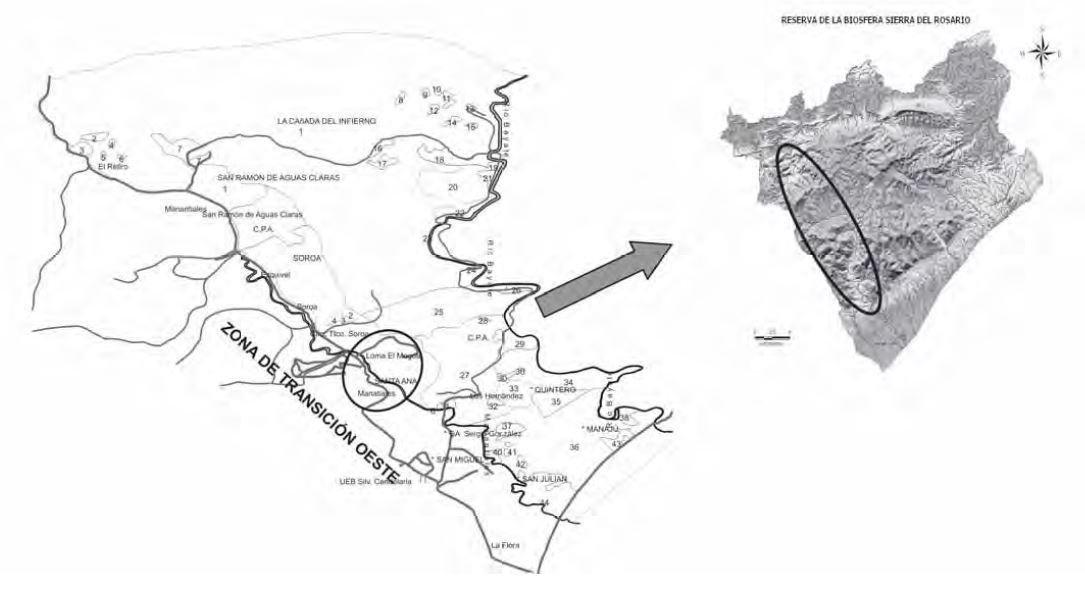
In this research, the anthropogenic fragmentation effects of vegetation on the conservation of cuban orchids are determined in the Mogote Mountain, located in the west zone of transition of the Biosphere Reserve «Sierra del Rosario.»
The field studies were done through the transept methods for data collection. The disturbance effects were evaluated by four categories taking into consideration the main activities in the area. The main disturbances are associated to the tourist areas like roads, interpretive trek and the exploitation of the forest wood and no wood products, which are higher daily.
Downloads
Article Details

This work is licensed under a Creative Commons Attribution-NonCommercial 4.0 International License.
Those authors who have publications with this journal accept the following terms of the License Attribution-NonCommercial 4.0 International (CC BY-NC 4.0):
You are free to:
- Share — copy and redistribute the material in any medium or format
- Adapt — remix, transform, and build upon the material
The licensor cannot revoke these freedoms as long as you follow the license terms.
Under the following terms:
- Attribution — You must give appropriate credit, provide a link to the license, and indicate if changes were made. You may do so in any reasonable manner, but not in any way that suggests the licensor endorses you or your use.
- NonCommercial — You may not use the material for commercial purposes.
- No additional restrictions — You may not apply legal terms or technological measures that legally restrict others from doing anything the license permits.
The journal is not responsible for the opinions and concepts expressed in the works, they are the sole responsibility of the authors. The Editor, with the assistance of the Editorial Committee, reserves the right to suggest or request advisable or necessary modifications. They are accepted to publish original scientific papers, research results of interest that have not been published or sent to another journal for the same purpose.
The mention of trademarks of equipment, instruments or specific materials is for identification purposes, and there is no promotional commitment in relation to them, neither by the authors nor by the publisher.
How to Cite
References
Álvarez, P. 1986. Tipología de los bosques de Cuba. En: Protección de los Bosques. Centro Universitario de Pinar del Río. p. 11-33.
Ayes, G. N. 2003. Medio Ambiente, Impacto y Desarrollo. Editorial Científico Técnica, La Habana. 17 p.
Bonet, A. 2003. Zonificación de Espacios Naturales Protegidos. En su: Gestión de Espacios protegidos. Materiales docentes 2002-2003. Universidad de Alicante. Departamento de Ecología. p. 186-197.
Capote, R. P., Menéndez, L., García E. E, Vilamajó, D., Ricardo, N., Urbino, J. Y Herrera, R. A. 1988. Flora y vegetación. En: Ecología de los Bosques Siempreverdes de la Sierra del Rosario. Proyecto MAB No. 1, 1974-1987. p. 100-130.
Christenson, E. 2003. Machu Picchu: Orchids. PROFONAPE, Lima, Perú. p 23-27.
Díaz Duma, M. A. 1988. Formas de vida de las orquídeas. En su: Las orquídeas nativas de Cuba. Editorial Científico Técnica. La Habana. p. 14-16.
Furrasola, G. 1987. Generalidades sobre la geología de la Sierra del Rosario. En: Ecología de los bosques siempre verde de la Sierra del Rosario. Cuba. Proyecto MAB No 1, 19741987. La Habana, Instituto de Ecología y sistemática. p.75
García García, M. 2006. Conservación y manejo in situ de la Biodiversidad en Huertos caseros y Fincas de Cuba. 145 h.. Tesis (en opción al grado científico de Doctor en Ciencias Ambientales). Universidad de Alicante. España.
Garibaldi, C. 2008. Efectos de la extracción y uso tradicional de la tierra sobre la estructura y dinámica de bosques fragmentados en la Península de Azuero, Panamá. 110 h.. Tesis (en opción al grado científico de Doctor en Ciencias Forestales). Universidad de Pinar del Río, Centro de Estudios Forestales.
López Trabanco, P. J. 1996. Catálogo etimológico de las orquídeas cubanas. España, Universidad de Alcalá. 4. p.
Menéndez, L., Capote, R. Y González, A. 1987. La Reserva de la Biosfera. Área de estudio. En: Ecología de los bosques siempre verde de la Sierra del Rosario. Cuba. Proyecto MAB No 1, 1974-1987. La Habana, Instituto de Ecología y sistemática. p.35.
Orta Pozo, S. 2007. Autogestión comunitaria para la conservación de orquídeas cubanas en la zona de transición oeste de la reserva de la Biosfera «Sierra del Rosario». Pinar del Río. 92 h.. Tesis (en opción al título de Master en Agroecología y Desarrollo Sostenible). Universidad de Pinar del Río.