Business outlook of Pinus maestrensis Bisse saw wood, in Granma
Article Sidebar
Main Article Content
Abstract
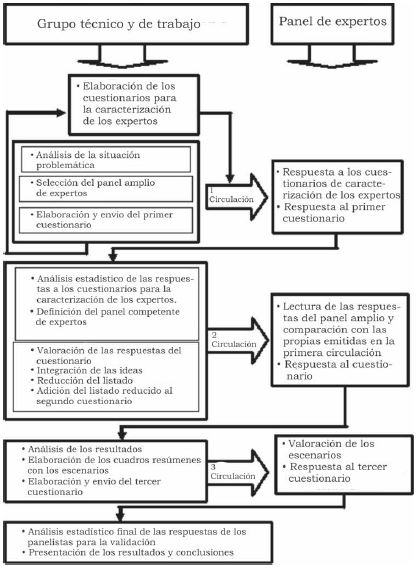
The objective of this investigation was the elaboration of future scenarios for the commercialization of the serrate wood of Pinus maestrensis Bisse in the forestry sector in Granma province. Using the Delphi method were created the scenarios taking into account the concurrence probability, the events importance, so as the occurrence date, with the collaboration of 16 experts. The estimation using the quiz, trying to see the opinions of convergence and the deduction of eventual consensus. The analysis of modified Boston Model, put the product in a not favorable position, it means that the product have a bad image in the market, working not so good in some identified segments where the competition is suffering, cash flow is not enough due to the low fund market or a little rentability. The concordance unit is significant to the evaluation of experts. There is a correlation and enough evidence to say with a 95% of truth. The scenarios till 2017 are characterized for the existence of important events and very important, with occurrence probability and control of occurrence date that are happening or will happen in less than 5 years. Marketing strategies are formulating in the Empresas Forestales Integrales of Granma more competitive and more adequate to the reality and work philosophy.
Downloads
Article Details

This work is licensed under a Creative Commons Attribution-NonCommercial 4.0 International License.
Those authors who have publications with this journal accept the following terms of the License Attribution-NonCommercial 4.0 International (CC BY-NC 4.0):
You are free to:
- Share — copy and redistribute the material in any medium or format
- Adapt — remix, transform, and build upon the material
The licensor cannot revoke these freedoms as long as you follow the license terms.
Under the following terms:
- Attribution — You must give appropriate credit, provide a link to the license, and indicate if changes were made. You may do so in any reasonable manner, but not in any way that suggests the licensor endorses you or your use.
- NonCommercial — You may not use the material for commercial purposes.
- No additional restrictions — You may not apply legal terms or technological measures that legally restrict others from doing anything the license permits.
The journal is not responsible for the opinions and concepts expressed in the works, they are the sole responsibility of the authors. The Editor, with the assistance of the Editorial Committee, reserves the right to suggest or request advisable or necessary modifications. They are accepted to publish original scientific papers, research results of interest that have not been published or sent to another journal for the same purpose.
The mention of trademarks of equipment, instruments or specific materials is for identification purposes, and there is no promotional commitment in relation to them, neither by the authors nor by the publisher.
How to Cite
References
Astigarraga, E. 1999. El método Delphi. Universidad de Deusto. España, Facultada de CC.EE. y Empresariales. 18 p.
Canarotti, H. «Instrumentos de diagnóstico». (En línea) mayo 2001. Disponible en: http://www.monografias.com/trabajos18/ instrumentosdiagnosticos (consulta: noviembre, 7 2006).
Cruz Pérez, Y. 2004. Estrategia y plan de marketing para la resina de pino en la E.F.I. «La Palma». Pinar del Río. 141 p. Tesis (en opción al título de ingeniero forestal). Ministerio de Educación Superior. Cuba.
DIRECCIÓN NACIONAL FORESTAL. MINAG. 1997. Programa de Desarrollo Económico Forestal 1997-2015. (Inédito). Cuba.
González Pérez, M. 1996. Los programas estratégicos de carácter sectorial. Experiencias en el sector de la resina en Cuba. Ciudad de La Habana. 231 p. Tesis (en opción al grado científico de Doctora en Ciencias Económicas). Ministerio de Educación Superior.
Herrero, J. 2004. Estudio de tendencias y perspectivas del sector forestal en América Latina. Ciudad de La Habana. MINAGRI. Cuba. 78 p.
Nagel, J. Instrumentos de diagnóstico. (en línea) febrero 2001. Disponible en: http://www.monografias.com/trabajos18/instrumentosdiagnosticos. (consulta: noviembre, 10/2006).
Notario De La Torre, A. 1999. Apuntes sobre un compendio sobre metodología de la investigación científica. Pinar del Río. (Inédito). Cuba.
Porter, M. 1992. Estrategias competitivas. México. Editorial Continental. 450 p.
Santesmases, M. 1999. Marketing: Conceptos y estrategias. Madrid. Editorial Pirámide. 53 p.
SERVICIO ESTATAL FORESTAL GRANMA. 2006. Programa de Desarrollo Forestal hasta el 2015 Provincia Granma. 57 p.