Influencia del manejo del agua y del sustrato en la calidad de la planta de Eucalyptus grandis Hill ex Maiden en contenedores
Article Sidebar
Main Article Content
Abstract
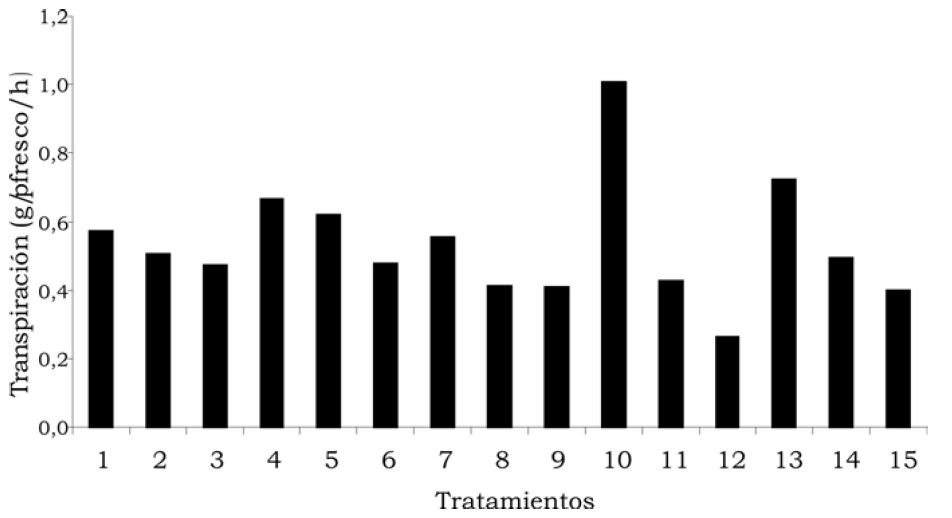
The reforestation programs that are carried out in the country require a good quality of plants in nursery. In this work is studied the influence of growing media and irrigation in the quality of the Eucalyptus grandis plant in the nursery of Pinar del Río University. To the different used growing media were obtaining the chemical composition and physical properties. Parameters and morphological index of the plants were evaluated, as well as their nutritious state. Physiologic parameters are analyzed as: cuticular transpiration and hidric potential at dawn and at noon. The Scholander pressure chamber is used for the determination of the hidric potential. It was carried out an economic valuation in function of the growing media studied and irrigation. The results demonstrated that the smallest values of cuticular transpiration, as well as the smallest differences of hidric potential at dawn and at noon they base the irrigation in alternating days in the hardening phase, what demonstrates that the plant has created a mechanism able to support the hidric deficit. It is corroborated that the new proposed growing media presents a better behaviour as for the morphological attributes of the plants taken place with equal result in the survival, height and diameter at neck of the root in the plantation and inclusive their decrease in the production costs. The growing media compound for filter cake (cachaza) between 50 and 90% more peat 40% and hen-dung and bat manure 10%, they are those of better results.
Downloads
Article Details

This work is licensed under a Creative Commons Attribution-NonCommercial 4.0 International License.
Those authors who have publications with this journal accept the following terms of the License Attribution-NonCommercial 4.0 International (CC BY-NC 4.0):
You are free to:
- Share — copy and redistribute the material in any medium or format
- Adapt — remix, transform, and build upon the material
The licensor cannot revoke these freedoms as long as you follow the license terms.
Under the following terms:
- Attribution — You must give appropriate credit, provide a link to the license, and indicate if changes were made. You may do so in any reasonable manner, but not in any way that suggests the licensor endorses you or your use.
- NonCommercial — You may not use the material for commercial purposes.
- No additional restrictions — You may not apply legal terms or technological measures that legally restrict others from doing anything the license permits.
The journal is not responsible for the opinions and concepts expressed in the works, they are the sole responsibility of the authors. The Editor, with the assistance of the Editorial Committee, reserves the right to suggest or request advisable or necessary modifications. They are accepted to publish original scientific papers, research results of interest that have not been published or sent to another journal for the same purpose.
The mention of trademarks of equipment, instruments or specific materials is for identification purposes, and there is no promotional commitment in relation to them, neither by the authors nor by the publisher.
How to Cite
References
Barceló, J.; G. Nicolás; G. Sabater; R. Sánchez: Fisiología vegetal, Ediciones Pirámide, Madrid, 1983.
Birchler, T.; R. Rose; A. Royo; M. Pardo: «La planta ideal: revisión del concepto. Parámetros definitorios e implementación práctica», Revista de Investigación Agraria, Sistemas y Recursos Forestales 7 (2):109-119, Madrid, 1998.
Cobas, L. M.: «Caracterización de los atributos de calidad de la planta de Hibiscus elatus. S W cultivada en tubetes. Pinar del Río». Tesis en opción al grado científico de Doctor en Ciencias Forestales, Universidad de Pinar del Río, Cuba, 2001.
Escarré, A.: «Medida del potencial hídrico. Método de la bomba de Scholander (metodología)». Curso de postgrado impartido en la Universidad de Pinar del Río, Cuba, 2003.
Oliet, J. A.: La calidad de la planta forestal en vivero, ETSIAM, Córdoba, España, 2000.
––––: Aplicaciones de la medida del estado hídrico en el vivero, Universidad de Córdoba, España, 2001.
Thompson, B.: «Seedling Morphological Evaluation. What Can You Tell by Looking?», Evaluating Seedling Quality: Principles, Procedures and Predictive Abilities of Major Test. Oregon State University, EE.UU., 1985, pp. 59-69.
Villar, S. P.; B. L. Ocaña; R. J. Peñuelas; M. I. Carrasco; L. S. Domínguez: «Efectos de diferentes niveles de endurecimiento por estrés hídrico en el contenido de nutrientes y la resistencia a la desecación de plántulas de Pinus halepensis Mill.», Actas del I Congreso Forestal Hispano-Luso, vol. 3, 1997, pp. 673-678.