Principales características físico-mecánicas de la madera de cinco especies forestales de la Cordillera de Guaniguanico
Article Sidebar
Main Article Content
Abstract
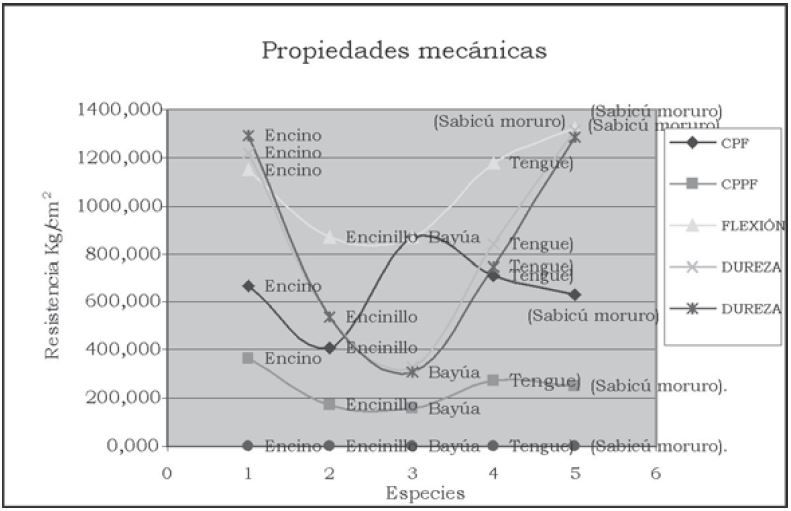
In the study they are related the physicalmechanical characteristics of five species of the mountain range of Guaniguanico: Quercus cubana A. Rich. (encino), Pithecellobium obovale (A. Rich.) Wr. (encinillo), Zantthoxylum elephantiasis Macfd. (bayúa), Poepiggia procera Presl. (tengue), Pithecellobium arboreum (L.) Urb. (sabicú moruro). The results of the research throw that the normal density is superior in all the cases 0,600 g/cm3, being the highest securities for the encino, with 0,871 g/cm3. The contraction relationships are favorable (1,6) except for the tengue that is lightly superior with 1,8. This result supposes quite uniform dimensional changes during the drying. In mechanical property, they are indicated bigger securities for the encino and the sabicú moruro, being in the static flexion more than 1000 kgf/cm2 and the tangential hardness as radial above 1000 kg. The compression so much parallel, as perpendicular they had maximum securities of 870 kgf/cm2 for the bayua and 363 kgf/cm2 for the encino.
Downloads
Article Details

This work is licensed under a Creative Commons Attribution-NonCommercial 4.0 International License.
Those authors who have publications with this journal accept the following terms of the License Attribution-NonCommercial 4.0 International (CC BY-NC 4.0):
You are free to:
- Share — copy and redistribute the material in any medium or format
- Adapt — remix, transform, and build upon the material
The licensor cannot revoke these freedoms as long as you follow the license terms.
Under the following terms:
- Attribution — You must give appropriate credit, provide a link to the license, and indicate if changes were made. You may do so in any reasonable manner, but not in any way that suggests the licensor endorses you or your use.
- NonCommercial — You may not use the material for commercial purposes.
- No additional restrictions — You may not apply legal terms or technological measures that legally restrict others from doing anything the license permits.
The journal is not responsible for the opinions and concepts expressed in the works, they are the sole responsibility of the authors. The Editor, with the assistance of the Editorial Committee, reserves the right to suggest or request advisable or necessary modifications. They are accepted to publish original scientific papers, research results of interest that have not been published or sent to another journal for the same purpose.
The mention of trademarks of equipment, instruments or specific materials is for identification purposes, and there is no promotional commitment in relation to them, neither by the authors nor by the publisher.
How to Cite
References
AMERICAN SOCIETY FOR TESTING AND MATERIALS: «Paint, Naval Store, Cellolose, Wax, Polish, Wood, Acoustical Materials», Sandwich and Building Contrucction, Fire tests, Part 4, Philadelfia, 1955.
Del Risco, E.: Los bosques de Cuba. Su historia y características, Ed. Científico-Técnica, La Habana, 1995.
Fors, J.: Maderas cubanas, Ed.. INRA, La Habana, 1965.
García, J. M. ; Pedro P. Henry; María V. Mantilla: »Pérdida de humedad de la madera de cinco especies de importancia económica del macizo montañoso Sagua-Nipe-Baracoa», IV Simposio Internacional sobre Manejo Sostenible de los Recursos Naturales, SINFOR 2006, La Habana.
Ibáñez, A.: Propiedades y usos de 50 especies maderables que crecen en Cuba (propuesta a premio Academia 2001), La Habana, 2002.
NC 43-27:87 «Propiedades físico-mecánicas».
Soler, M.: Mil maderas II, Editorial de la UVP, 2004.
NORMAS ISO-1975 «Draft International Standard» ISO 3133, ISO 3137.
Sotomayor, J. R.: «Tabla Fitecma de clasificación de características mecánicas de maderas mexicanas», Universidad Michoacana de San Nicolás de Hidalgo, México, 2002.
UNE 56-540-78 «Características físico-mecánicas de la madera: interpretación de los resultados de los ensayos. Norma española», 1978.