Rehabilitación y ordenamiento de la faja hidrorreguladora del río Cuyaguateje
Article Sidebar
Main Article Content
Abstract
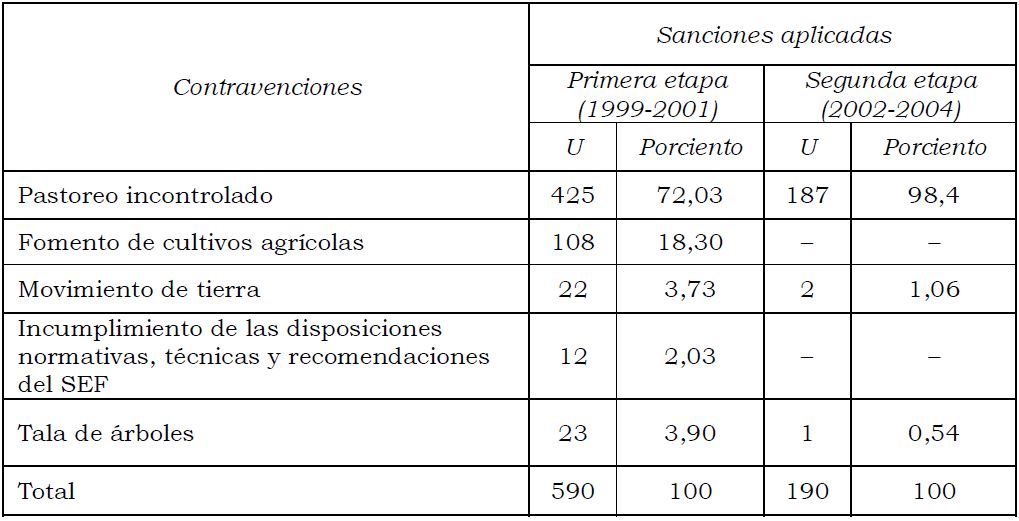
It is studied the hydroregulator strip of Cuyaguateje River, based on the deterioration of their flora, of their fauna, the erosion of their soils and the other components that are related with the same one, because of the inadequate handling of the natural resources. The authors intend as objective, contribute to the protection of this hydroregulator strip, understood in the Guane municipality; through the reforestation and conservation of soils, flora and fauna, on the base of the sustainability, marking a social and environmental impact in the areas and communities, that it embraces the region. For their execution they were carried out inventories at use of land in the whole study area and the proceedings of all their owners. Later on both riverbanks of the river were reforested, with distance of plantation of 3 x 3 m for the timber species and of 4 x 4 m for the fruit species. The site preparation was carried out in a manual way in plantation holes, being aided of weeding in the area. The better adapted species to the existent conditions in the hydroregulator strip after the reforestation were: Hibiscus elatus (mahoe), Andira inermis (yaba), Bambusa vulgaris (brave cane) and Manguifera indica (mango), Psidium guajava (guayaba). The actions of environmental education in the area allowed to elevate the conscience of its residents, all that which impacted in the reached results and in the decrease of the infractions and breaches.
Downloads
Article Details

This work is licensed under a Creative Commons Attribution-NonCommercial 4.0 International License.
Those authors who have publications with this journal accept the following terms of the License Attribution-NonCommercial 4.0 International (CC BY-NC 4.0):
You are free to:
- Share — copy and redistribute the material in any medium or format
- Adapt — remix, transform, and build upon the material
The licensor cannot revoke these freedoms as long as you follow the license terms.
Under the following terms:
- Attribution — You must give appropriate credit, provide a link to the license, and indicate if changes were made. You may do so in any reasonable manner, but not in any way that suggests the licensor endorses you or your use.
- NonCommercial — You may not use the material for commercial purposes.
- No additional restrictions — You may not apply legal terms or technological measures that legally restrict others from doing anything the license permits.
The journal is not responsible for the opinions and concepts expressed in the works, they are the sole responsibility of the authors. The Editor, with the assistance of the Editorial Committee, reserves the right to suggest or request advisable or necessary modifications. They are accepted to publish original scientific papers, research results of interest that have not been published or sent to another journal for the same purpose.
The mention of trademarks of equipment, instruments or specific materials is for identification purposes, and there is no promotional commitment in relation to them, neither by the authors nor by the publisher.
How to Cite
References
Álvarez, P.: «Valoración silvícola para el enriquecimiento de bosques naturales sobreexplotados», Revista Forestal Baracoa, vol. 24 (1):3-11, 2005.
Cordero, E. M.; A. Mercadet; J. M. Montalvo; J. R. Pérez; Y. Cordero; M. A. Betancourt: «Resultados del inventario forestal realizado en las plantaciones de Bambusa vulgaris Schard var. vulgaris en el municipio de Guane, perteneciente a la empresa forestal integral Macurije de la provincia de Pinar del Río» Revista Forestal Baracoa, vol. 23 (2):33-37, 2004.
Herrero, J.: «Función hidrológica y antierosiva de los bosques de las zonas montañosas y premontañosas de Cuba». Tesis en opción al grado científico de Doctor en Ciencias Agrícolas, INCA, 1992.
Samek, V.: Elementos de silvicultura de los bosques latifolios, Ciencia y Técnica, La Habana, 1974.