Valoración de los costos de establecimiento de la regeneración natural
Article Sidebar
Main Article Content
Abstract
The natural regeneration in coniferous forests is a method of possible application in de silvicultural context of Cuba, where the stands renovation is made by planting. In particular case of Caribbean pine (Pinus caribaea var. caribaea) the natural regeneration there is not applied because the abundant seeds sources and easy management in nursery. However, one deep analysis shows the specie possibilities for natural reproduction and economics and ecological advantages by the high numbers of plants obtained by area. Besides, the reductions in environment impacts to be considered above all in sites with pour nutrient content.
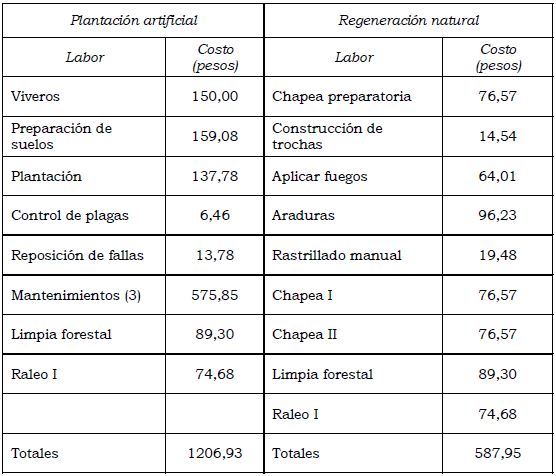
In this paper were assessed a brief economic analysis of this method derived of the natural regeneration trials located in the Gilberto Leon Forest District that belong to Minas Forest Enterprise of Pinar del Río.
Here, we contrasted some areas regenerated by natural reproduction with artificial plantations since establishment until the first clear felling in relation to silvicultural establishment costs and timber costs as a function of different rotations by the possible elongation of the rotation in naturally regenerated way.
Downloads
Article Details

This work is licensed under a Creative Commons Attribution-NonCommercial 4.0 International License.
Those authors who have publications with this journal accept the following terms of the License Attribution-NonCommercial 4.0 International (CC BY-NC 4.0):
You are free to:
- Share — copy and redistribute the material in any medium or format
- Adapt — remix, transform, and build upon the material
The licensor cannot revoke these freedoms as long as you follow the license terms.
Under the following terms:
- Attribution — You must give appropriate credit, provide a link to the license, and indicate if changes were made. You may do so in any reasonable manner, but not in any way that suggests the licensor endorses you or your use.
- NonCommercial — You may not use the material for commercial purposes.
- No additional restrictions — You may not apply legal terms or technological measures that legally restrict others from doing anything the license permits.
The journal is not responsible for the opinions and concepts expressed in the works, they are the sole responsibility of the authors. The Editor, with the assistance of the Editorial Committee, reserves the right to suggest or request advisable or necessary modifications. They are accepted to publish original scientific papers, research results of interest that have not been published or sent to another journal for the same purpose.
The mention of trademarks of equipment, instruments or specific materials is for identification purposes, and there is no promotional commitment in relation to them, neither by the authors nor by the publisher.
How to Cite
References
Agee,J, K.: «Fire and Pine Ecosystems», Ecology and Biogeography of Pinus, Cambridge Universyte Press, 1998, pp.193-218.
Burley, J. et al.: «Variación de la calidad de la madera de Pinus caribaea var. cariabea Barret y Golfori: análisis preliminar de cinco árboles de plantaciones de Topes de Collantes (Cuba)», Revista Forestal Baracoa, año 3 (3-4), 1973, pp. 42-60.
Fuentes, R.; M. Hidalgo: Problemas de economía aplicada, Estudios Pirámide, Madrid, 1985, pp.185-191.
Jacobs, M.: La economía verde, Medio Ambiente, Desarrollo Sostenible y Política del Futuro, ICARIA, 1991.
Kellmann, M.; R. Tackaberry: Tropical nvironments. The Functioning and Management of Tropical Ecosystem, Routeledge, 1997.
Kimmins, J. P.: «Forest Ecology», A Foundation for Sustainable Management, 2.a ed., 1996
Madrigal, A.: Ordenación de montes arbolados, Ministerio de la Agricultura, Pesca y Alimentación, ICONA, 1944.
Raddi, A.: «Respecto a la valoración de las externalidades del monte», Montes (64):75-75, 2001.
Samek, V.: Elementos de silvicultura de los pinares, Universidad de La Habana.