Experiencia del aprovechamiento de los residuos en un aserrío
Article Sidebar
Main Article Content
Abstract
The faulty technology used in the processes of having sawed of the wood generates high volumes of waste that are agents of environmental contamination. Most of these residuals, they accumulate in the patios of the sawmills and in most of the cases they are converted in ashy, liberating great quantity from CO2 to the atmosphere, that which is a threat for the environmental health and a decisive factor in the progressive deterioration of the natural resources.
The objective of the work is to carry out a proposal of productive use of the waste with the end to diversify the production of forest products by means of technologies of under economic impact as well as to estimate the levels of the environmental cost for effect of the practice of you burn them. The work was carried out with the species Pinus caribaea Mor. and Pinus tropicalis Mor. that are processed in the sawmill of Pons, Mines of Matahambre.
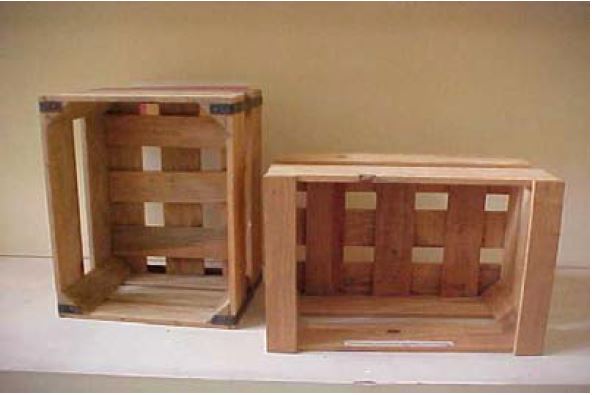
It was proven that the one recycled of the waste in the production of packings, crafts, wood cement composite, charcoal is technically possible, social and economic because facilitates to add value to the primary production of the aserrío and to reduce the polluting load for emissions of toxic air.
The strategy of using wood wastes is a practice of technological innovation that provides additional earnings to the Company for concept of sale of forest products and it stimulates the creativity of the actors in the process of generation of new knowledge.
Downloads
Article Details

This work is licensed under a Creative Commons Attribution-NonCommercial 4.0 International License.
Those authors who have publications with this journal accept the following terms of the License Attribution-NonCommercial 4.0 International (CC BY-NC 4.0):
You are free to:
- Share — copy and redistribute the material in any medium or format
- Adapt — remix, transform, and build upon the material
The licensor cannot revoke these freedoms as long as you follow the license terms.
Under the following terms:
- Attribution — You must give appropriate credit, provide a link to the license, and indicate if changes were made. You may do so in any reasonable manner, but not in any way that suggests the licensor endorses you or your use.
- NonCommercial — You may not use the material for commercial purposes.
- No additional restrictions — You may not apply legal terms or technological measures that legally restrict others from doing anything the license permits.
The journal is not responsible for the opinions and concepts expressed in the works, they are the sole responsibility of the authors. The Editor, with the assistance of the Editorial Committee, reserves the right to suggest or request advisable or necessary modifications. They are accepted to publish original scientific papers, research results of interest that have not been published or sent to another journal for the same purpose.
The mention of trademarks of equipment, instruments or specific materials is for identification purposes, and there is no promotional commitment in relation to them, neither by the authors nor by the publisher.
How to Cite
References
AITIM: «El reciclado de los residuos de madera», Boletín de Información Técnica 188:9-10, 1977.
Álvarez, E.: «Perspectivas del aprovechamiento del aserrín para diferentes fines. Pinar del Río, Revista Forestal Centroamericana (39-40), 2002.
Bequete, F.: «Un mundo sin desecho, una utopía?», revista Correos (XLIX):43-45, 1996.
Contreras, W.; M. Owen: «Prototipo estructural Mucunutan I para la construcción de viviendas rurales modernas para los páramos venezolanos empleando la madera y las tecnologías constructivas alternativas», Revista Forestal Venezolana 44 (2):53-61, 2000.
González, Silvia: «Las etiquetas autoadhesivas», Cubaenvases. (262):12-14, 1995.
Ibáñez, A.; K. Manzanares; M. Sosa: «Compendio de 56 especies cubanas, tropicales y de otras regiones» [disco], Instituto de Investigaciones Forestales, La Habana, 2000.
Roche, I.; J. O’connor; P. Tetu: Los productos de la madera y la producción sostenible, XII Congreso Forestal Mundial, Québec, 2003.
Sánchez, E.: «Embalajes realizados con residuos maderables de costaneras». Tesis por el título de Máster en Ciencias Forestales, Universidad de Pinar del Río, Cuba, 2001.
Sarré, A.: «El proceso de elaboración secundaria», Editorial, Actualidad Forestal Tropical 9(1):1-2, 2001.
Soriano, F.; T. R. E. Rondero; A. C. Manalo; C. R. Carino; E. A. Bonaagua: «Application of Wood Wool Cement Boards for Shop-Fabricated Emergency Shelters in the Philippines», Proceeding of Workshop Wood Cement Composites in the AsiaPacific Region, ACIAR, Canberra, 2002.
Soto, J.; J. A. Aguirre; J. Méndez; G. Páez: «Evaluación económica y ambiental de residuos maderables en aserraderos de Costa Rica», Revista Forestal Centroamericana, 23-29, 2000.
Velásquez, D.; K. Manzanares; M. Castillo: «Instructivo técnico de autoconstrucción, DTA, La Habana, 2000.
Yossifov, N.; Palmina Khristova; S. Gabi: Agri-Cement Panels from Sunflower Stalks, Spokaine, Inorganic Bonded Wood and Fiber Composite Conference, 1997.