Influencia de las talas selectivas sobre la abundancia de la jutía conga (Capromys pilorides Say.) en la reserva de la biosfera Península de Guanahacabibes
Article Sidebar
Main Article Content
Abstract
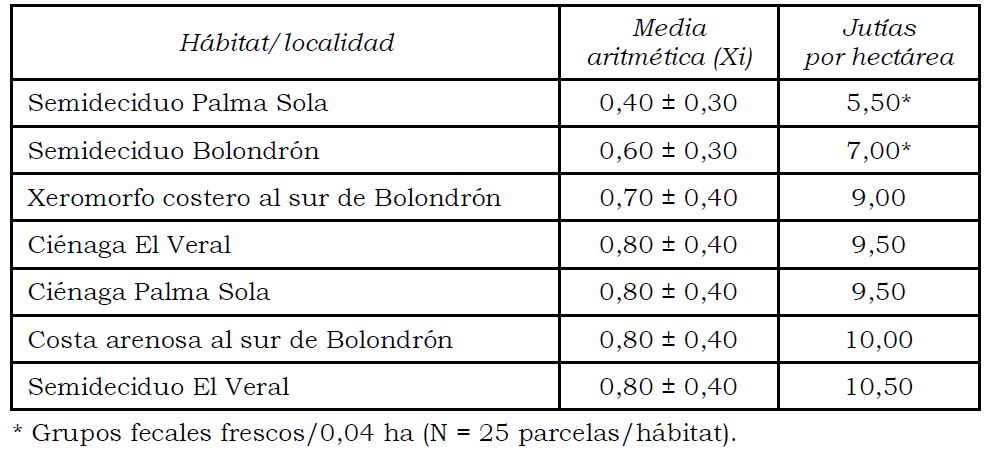
The present research work was carried out with the purpose of characterizing the effect of the anthropical variable, environmental and dendrometric parameters on the populations of Capromys pilorides Say (jutía conga), Península of Guanahacabibes. The works were developed under the conditions of the semideciduos forests, defining parcels of 20 x 20 meters (25 in total) in areas with 5, 10, and more than 40 years after felling in the Natural Reservation. The used sampling was the aleatory simple, being defined the first parcel randomly and later the other ones were located in a systematic way. In each parcel were determinates the fresh jutias´s excrete and also the number individuals of given species. There were determinated another parameters such as rocky soils, height and diameter of the trees, canopy density, number of alive and dead plants and the anthropopathy degree. The main results were: The count method for excrete it can be used as a good estimator of the jutias/ ha density under the conditions where the investigation was developed. The jutías/ha densities varied from 5,5 up to 10,5 in closed narrow relationship with the changes taken place in the environmental variables, dendrometric and the antropización degree to that it has been subjected the forest semideciduo.
Downloads
Article Details

This work is licensed under a Creative Commons Attribution-NonCommercial 4.0 International License.
Those authors who have publications with this journal accept the following terms of the License Attribution-NonCommercial 4.0 International (CC BY-NC 4.0):
You are free to:
- Share — copy and redistribute the material in any medium or format
- Adapt — remix, transform, and build upon the material
The licensor cannot revoke these freedoms as long as you follow the license terms.
Under the following terms:
- Attribution — You must give appropriate credit, provide a link to the license, and indicate if changes were made. You may do so in any reasonable manner, but not in any way that suggests the licensor endorses you or your use.
- NonCommercial — You may not use the material for commercial purposes.
- No additional restrictions — You may not apply legal terms or technological measures that legally restrict others from doing anything the license permits.
The journal is not responsible for the opinions and concepts expressed in the works, they are the sole responsibility of the authors. The Editor, with the assistance of the Editorial Committee, reserves the right to suggest or request advisable or necessary modifications. They are accepted to publish original scientific papers, research results of interest that have not been published or sent to another journal for the same purpose.
The mention of trademarks of equipment, instruments or specific materials is for identification purposes, and there is no promotional commitment in relation to them, neither by the authors nor by the publisher.
How to Cite
References
Amend, S.; T. AMEND:Espacios sin habitantes. Parques Nacionales de América del Sur, Ed. Nueva Sociedad, UICN, Suiza, 1992, pp. 12-29.
Batisse, M.: «Developing and Focusing the Biosphere Reserve Concept», Nature and Resources, 1:20-29, 1986.
Berovides, A. V.; A. Comas: «Valoración de la jutía conga, Capromys pilorides (Rhodentia, Capromidae) como recurso natural», Biología 7(2-3):125-138, 1993.
Camarillo, J. L; E. Kato; J. Rivera: Manejo cuantitativo de vertebrados terrestres, Ed. ENEP, Iztacala, México, 1991.
Comas, A; F. Rosales; R. González: «Datos sobre la alimentación de la jutía conga en el área protegida Sierra del Chorrito» Biología 1, 1989.
Hernández, E.: «Influencia de algunos elementos de manejo en vida libre sobre la densidad de la jutía conga (Capromys pilorides) en el Valle de San Andrés». Tesis de Diploma en opción al título de Ingeniero Forestal, Universidad de Pinar del Río, Cuba, 2003.
Noon, R.: «Tecniches for Sanpling Avian Habitats USDA», Forest Research General Tech. Report. RM-87, 1981.
Smith, R; V. Berovides: «Ecomorfología y rendimiento de la jutía conga (Capromys pilorides Say)», Poeyana 279:1-19, 1984.
Wells, M. P.; K. E. Brandon: «The Principles and Practice of Buffer Zones and Local Participation in Biodiversity Conservation», SRL. 17-29, 1993.