Adiciones al conocimiento de la Reserva Florística Manejada Monte Grande, municipio de Guáimaro, Camagüey, Cuba
Article Sidebar
Main Article Content
Abstract
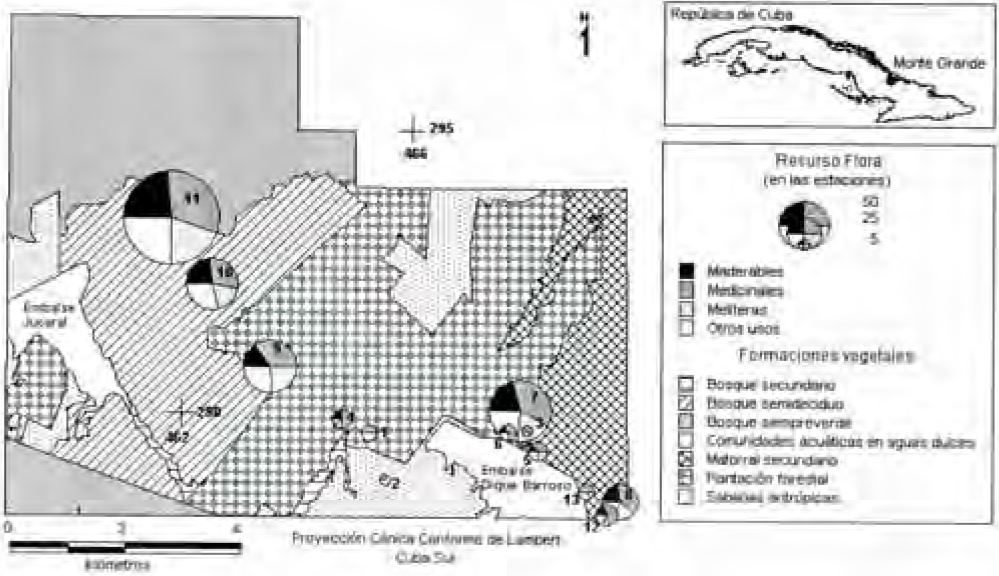
This work contributes new elements to the knowledge of the floristic resource of Monte Grande, as part of the researchs to establish a strategy of sucesional reforestation in the areas of more antropic affectation, with a view to the recovery of the affected forests ecosystems. The collections were carried out in 13 stations that included different types of vegetation among them: evergreen microphyll forests; secondary forests and thickets; secondary, ruderal, segetal and marshy vegetation. Plants of two freshwater communities were taken as complement to the information of the flora, because had not been collected before. 67% of taxa richness is in evergreen microphyll forests known as La Majagua and Los Robles. They constitute new reports for the town 73 taxa. The endemism index is of 10.7%; of them the pancubans corresponds to 64.7%, and the station 11 has the biggest representativeness of endemic. 76% of the taxa are useful to the man.
Downloads
Article Details

This work is licensed under a Creative Commons Attribution-NonCommercial 4.0 International License.
Those authors who have publications with this journal accept the following terms of the License Attribution-NonCommercial 4.0 International (CC BY-NC 4.0):
You are free to:
- Share — copy and redistribute the material in any medium or format
- Adapt — remix, transform, and build upon the material
The licensor cannot revoke these freedoms as long as you follow the license terms.
Under the following terms:
- Attribution — You must give appropriate credit, provide a link to the license, and indicate if changes were made. You may do so in any reasonable manner, but not in any way that suggests the licensor endorses you or your use.
- NonCommercial — You may not use the material for commercial purposes.
- No additional restrictions — You may not apply legal terms or technological measures that legally restrict others from doing anything the license permits.
The journal is not responsible for the opinions and concepts expressed in the works, they are the sole responsibility of the authors. The Editor, with the assistance of the Editorial Committee, reserves the right to suggest or request advisable or necessary modifications. They are accepted to publish original scientific papers, research results of interest that have not been published or sent to another journal for the same purpose.
The mention of trademarks of equipment, instruments or specific materials is for identification purposes, and there is no promotional commitment in relation to them, neither by the authors nor by the publisher.
How to Cite
References
Adams, C. D.: Flowering Plants of Jamaica, The University Press, Glasgow, Gran Bretaña, 1972.
Alain Hnos.: Flora de Cuba, vol. V, Publ. Asociación de Estudiantes de Ciencias Biológicas, Universidad de La Habana, 1964.
––––: Flora de Cuba. Suplemento, Instituto Cubano del Libro, La Habana, 1974.
Arias, R.: «Árboles nativos de uso múltiple utilizados por pequeños productores de Guatemala», Revista Forestal Centroamericana 3(7):10-15, 1994.
Arias, I.: «Araceae», Flora de la República de Cuba, Serie A. Plantas Vasculares. Fascículo 1(1), Koeltz Scientific Books, 1998.
Barreto, A.: «Las leguminosas (Fabaceae) de Cuba, I. Subfamilia Caesalpinioideae», Collectanea 24:6-148, 1998.
Bässler, M.: «Mimosaceae», Flora de la República de Cuba, Serie A. Plantas Vasculares. Fascículo 2, Koeltz Scientific Books, 1998.
Borhidi, A.: «Fundamentos de geobotánica en Cuba». Tesis para el grado de Doctor en Ciencias Biológicas, Budapest, Hungría, 1976.
Borhidi, A. & O. Muñiz: «The Phytogeographic Survey of Cuba. II. Floristic Relationships and Phytogeographic Subdivision», Acta Bot. Hungarica 32(1-4):3-48, 1986.
Catasús, L.: «Las gramíneas (Poaceae) de Cuba, I.», Fontqueria 46:1-259, 1997.
Capote, R. & R. Berazaín: «Clasificación de las formaciones vegetales de Cuba», Rev. Jardín Bot. Nac. 5(2):1-49, 1984.
COLECTIVO DE AUTORES: «CD Atlas multimedia de la flora medicinal potencial de la provincia de Camagüey», Centro de Investigaciones del Medio Ambiente, Camagüey, Cuba, 2002.
EE. UU.:Tropical Legumes: Resources for the Future, National Academy of Science, Washington DC., EE. UU., 1979.
Flores, J. C.; C. Martínez; M. Olvera; R. Galván & C. Chávez: «Potencial de algunas leguminosas de la flora yucatense como alimento humano y/o animal», Turrialba 38 (2):159-162, 1988.
Fors, A. J.: Maderas cubanas, 4a. ed. La Habana, 1957.
Fuentes, V.: «Las plantas medicinales de Cuba». Tesis para el grado de Doctor en Ciencias Biológicas, La Habana, 1988.
Havard-Duclos, B.: Las plantas forrajeras tropicales, La Habana, 1969.
Hernández, J. & M. E. López: «Lista preliminar de plantas tintóreas que crecen en Cuba», Rev. Jardín Bot. Nac. 11 (2), 1991.
León Hno.: Flora de Cuba, vol. I, Contrib. Ocas. Mus. Hist. Nat. Coll. La Salle, La Habana, 1946.
León Hno. Y Hno. Alain: Flora de Cuba, vol. II, Contrib. Ocas. Mus. Hist. Nat. Coll. La Salle, La Habana, 1951.
––––: Flora de Cuba, vol. III, Contrib. Ocas. Mus. Hist. Nat. Coll. La Salle, La Habana, 1953.
––––: Flora de Cuba, vol. IV, Contrib. Ocas. Mus.
Hist. Nat. Coll. La Salle, La Habana, 1957.
Ordext, G. S.: Flora apícola de la América tropical, Ed. Científico-Técnica, La Habana, 1978.
Pérez, E.; J. Ávila; P. Herrera; N. Enríquez: «Flora y vegetación de la localidad Monte Grande, municipio de Guáimaro, Camagüey, Cuba», Acta Botánica Cubana 94:1-28, 1994.
Roig, J. T.: Plantas medicinales, aromáticas o venenosas de Cuba», Ed. Ciencia y Técnica, La Habana, 1974.