Certificación del carbono retenido por las empresas forestales y bases para su reconocimiento ambiental
Article Sidebar
Main Article Content
Abstract
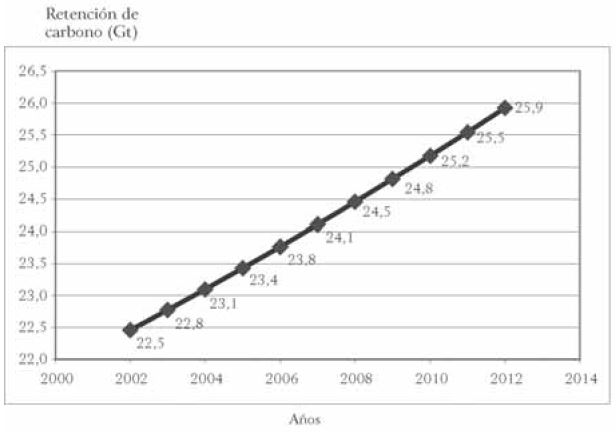
The authors have proposed a methodology that has been adapted to national conditions and species in order to certify, for a base year, the amount of carbon retained by the enterprise in their natural forests and plantations, including the soils where they are developed, its unforested areas and its no forest areas, taking into account by one hand that the management proyect of a forest enterprise establish how its natural resources must be used during a 10 year period and by other hand, the General Guides for inventories of greenhouse gases of International Panel of Climatic Change (IPCC). From the total amount of carbon retained in the base year and considering forests especificities of the enterprise, it is established how calculate the total time required in order to cover with forest all available lands and how, during the next 10 years, will evolve the amount of retained carbon (base line). Those results will make possible to evaluate in the future how the enterprise has implemented its management in order to fullfill its carbon base line, establishing with that the bases for creation of an environmental recognition, whose objective would be to estimulate the environmental services realized by forestry cuban enterprises.
Downloads
Article Details

This work is licensed under a Creative Commons Attribution-NonCommercial 4.0 International License.
Those authors who have publications with this journal accept the following terms of the License Attribution-NonCommercial 4.0 International (CC BY-NC 4.0):
You are free to:
- Share — copy and redistribute the material in any medium or format
- Adapt — remix, transform, and build upon the material
The licensor cannot revoke these freedoms as long as you follow the license terms.
Under the following terms:
- Attribution — You must give appropriate credit, provide a link to the license, and indicate if changes were made. You may do so in any reasonable manner, but not in any way that suggests the licensor endorses you or your use.
- NonCommercial — You may not use the material for commercial purposes.
- No additional restrictions — You may not apply legal terms or technological measures that legally restrict others from doing anything the license permits.
The journal is not responsible for the opinions and concepts expressed in the works, they are the sole responsibility of the authors. The Editor, with the assistance of the Editorial Committee, reserves the right to suggest or request advisable or necessary modifications. They are accepted to publish original scientific papers, research results of interest that have not been published or sent to another journal for the same purpose.
The mention of trademarks of equipment, instruments or specific materials is for identification purposes, and there is no promotional commitment in relation to them, neither by the authors nor by the publisher.
How to Cite
References
Centella, A.; J. Llanes; L. Paz: Primera comunicación nacional de la República de Cuba a la Convención Marco de las Naciones Unidas sobre Cambio Climático, 2001.
Loguercio, G. A.: «Fijación de carbono: un beneficio adicional para proyectos forestales en Patagonia», Patagonia Forestal 8, no. 2, 2002.
Harmon, M. E.; O. N. Krankina; M. Yatskov Y E. Matthews: «Predicting Broad-Scale Carbon Stores of Woody Detritus from Plot-Level Data. P. 533-552», Assessment Methods for Soil Carbon, CRC Press, New York, 2001.
Bolin Y Sukamar. 2000. EN: M. Kanninen. 2001. Bosques tropicales y ciclo de Carbono. CATIE. Curso Internac. “Proyecto de Cambio Climático en los Sectores Forestal y Energético. Oportunidades de Desarrollo para los países latinoamericanos”.
Nabuurs Y Mohren. 1993. EN: M. Kanninen. 2001. Bosques tropicales y ciclo de Carbono. CATIE. Curso Internac. «Proyecto de Cambio Climático en los Sectores Forestal y Energético. Oportunidades de Desarrollo para los países latinoamericanos».
ICRAF-ASB. EN: M. Kanninen. 2001. Bosques tropicales y ciclo de Carbono. CATIE. Curso Internac. «Proyecto de Cambio Climático en los Sectores Forestal y Energético. Oportunidades de Desarrollo para los países latinoamericanos».
Adger Y Brown (1994). EN: M. Kanninen. 2001. Bosques tropicales y ciclo de Carbono. CATIE. Curso Internac. «Proyecto de Cambio Climático en los Sectores Forestal y Energético. Oportunidades de Desarrollo para los países latinoamericanos»).
Herrero, J. A. et al.: «Apoyo a la potencialidad y manejo de las plantaciones forestales dentro del mecanismo de desarrollo limpio». Proyecto preparado por la Dirección Forestal, MINAGRI, 2004.
Herrero, J. A. et al.: «Criterios e indicadores de manejo sostenible de los bosques cubanos», MINAGRI, La Habana, 2005.