Influencia de las formaciones vegetales sobre el peso de Capromys pilorides Say (jutía conga) Rodentia: Capromydae en la Reserva de la Biosfera, Península de Guanahacabibes, Pinar del Río, Cuba
Article Sidebar
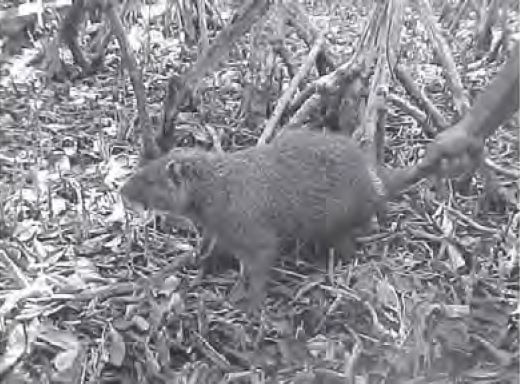
Main Article Content
Abstract
In order to determine the possible influence of vegetable influence underthe weight of adult population of the so called «jutia conga» (Capromyspilorides) an aleatory sampling was carried out in three locations of Guanahacabibes Peninsula (El Veral, Palma Sola and Bolondrón). Populationsthat live in the forest formation as semidecíduo, swamp, vegetation ofsandy coast and coastal xeromorfic bushs were studied. To capture «jutias», wooden rustic traps were used with baits corn and royal palm fruits inside the cages. In general, 210 male and female samples were captured and studied according to their corporal weight by means of a dynamometer. The weight of «jutias» according to their habitats were compared by means of Kruskal-Wallis non-parametric test, availability of categorized foods and weights and also by means of DunnetC test to compare the average weights. The results obtained that the higher weights belonged to the samples of semideciduos forest populations, followed by those of the swamp and those of the sandy coast vegetation. Low jutias’s weight turned to be those that live in the coastal xeromorfic formation. This proves the remarkable influence of the habitat on the corporal weight of the mature population of «jutias congas» in the Guanahacabibes Peninsula.
Downloads
Article Details

This work is licensed under a Creative Commons Attribution-NonCommercial 4.0 International License.
Those authors who have publications with this journal accept the following terms of the License Attribution-NonCommercial 4.0 International (CC BY-NC 4.0):
You are free to:
- Share — copy and redistribute the material in any medium or format
- Adapt — remix, transform, and build upon the material
The licensor cannot revoke these freedoms as long as you follow the license terms.
Under the following terms:
- Attribution — You must give appropriate credit, provide a link to the license, and indicate if changes were made. You may do so in any reasonable manner, but not in any way that suggests the licensor endorses you or your use.
- NonCommercial — You may not use the material for commercial purposes.
- No additional restrictions — You may not apply legal terms or technological measures that legally restrict others from doing anything the license permits.
The journal is not responsible for the opinions and concepts expressed in the works, they are the sole responsibility of the authors. The Editor, with the assistance of the Editorial Committee, reserves the right to suggest or request advisable or necessary modifications. They are accepted to publish original scientific papers, research results of interest that have not been published or sent to another journal for the same purpose.
The mention of trademarks of equipment, instruments or specific materials is for identification purposes, and there is no promotional commitment in relation to them, neither by the authors nor by the publisher.
How to Cite
References
Berovides, V.: «Evaluación de los capromidos de Cuba como recurso natural», Rev. Flora, Fauna y Áreas Silvestres, 1987.
Berovides, V.; R. Borroto; A. Camacho; A. Comas: (1990). «Valoración ecológica en poblaciones de jutía conga Capromys pilorides (Rodentia: Capromidae)», Ciencias Biológicas 23:44-58, 1990.
Berovides, V.; A. Comas: «The Critical Condition of Hutias in Cuba», Oryx 25:7-14, 1991.
––––: «Valoración de la jutía conga, Capromys pilorides (Rhodentia: Capromidae) como recurso natural», Biología 7 (2-3):125-138, 1993.
––––: «Abundancia de la jutía conga, Capromys pilorides (Rodentia: Capromydae) en varios hábitats», Biología 11:19-27, 1997b.
Cañizares, M.: «Selección de micro hábitat para la jutía conga (Capromys pilorides) y su uso como recurso natural». Tesis en opción al grado de Máster en Ciencias, Instituto de Ecología y Sistemática (IES), CENBIO/CITMA, 2003.
Kile, R.: «Rodents Under the Carving Knife», New Scientist 58-62, 1987.
Lora Chávez, L. A.: Contribución al estudio del género Capromys, Real Universidad Literaria de la Habana, 1895.
NRC (NATIONAL RESEARCH COUNCIL): Micro Livestock I y II, National Academic Press, Washington DC, 1991.
Negus, N. C.; P. BERGER; L. G. FORSLUND: «Reproductive Strategy of Microtus manatus», J. Mammalogy 58, 1997.
Silva, G.: The Conservation of Animal Diversity in Cuba, Columbia Univ. Press. New York, 1992.
Smith, R.; V. Berovides: «Ecomorfología y rendimiento de la jutía conga (Capromys pilorides Say)», Poeyana 279:1-19, 1984a.
––––: «Reproducción de la jutía conga (Capromys pilorides)», Poeyana 280:1-20, 1984b.
Varona, L. S.: Catálogo de mamíferos vivientes y extinguidos de las Antillas, Academia de Ciencias de Cuba, La Habana, 1974.