Nuevos registros de termites asociados a formaciones vegetales de la Reserva Ecológica Varahicacos
Article Sidebar
Main Article Content
Abstract
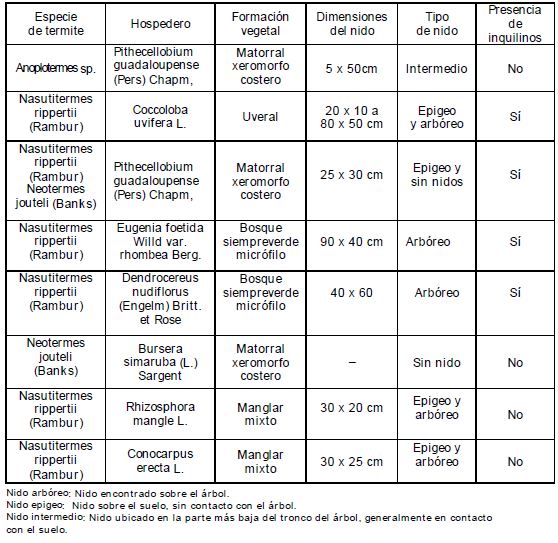
The termites constitutes one of the decayed groups of vegetable residuals, because of they present great importance for the balance of the forest ecosystems. These insects also intervene in the physical and chemical changes of the characteristics of the soil, particularly in the disorder of the profiles and ordination of the organic matter, as well as in the modification of the vegetation. In this paper they were carried out samplings in the vegetable formations using in their majority the ecological paths (The Muslims and The Lagoon) and the collection of the termites according to the methodology of the forest pathological inventory. The objective of thist paper is to inform and to register termites for the first time in the Varahicacos Ecological Reserve. A total of three genus of termites: Nasutitermes, Anoplotermes and Neotermes were opposing associated to the autochthonous vegetation of the reserve. The species more affected for termites are: Coccoloba uvífera L, Pithecellobium guadaloupense (Pers) Chapm, Eugenia foetida Willd var rhombea Berg, Dendrocereus nudiflorus (Engelm) Britt. et Rose, Bursera simaruba (L.) Sargent, Rhizosphora mangrove L. and Conocarpus erecta L. The uveral was the vegetable formation most deteriorated of the reserve by termites action.
Downloads
Article Details

This work is licensed under a Creative Commons Attribution-NonCommercial 4.0 International License.
Those authors who have publications with this journal accept the following terms of the License Attribution-NonCommercial 4.0 International (CC BY-NC 4.0):
You are free to:
- Share — copy and redistribute the material in any medium or format
- Adapt — remix, transform, and build upon the material
The licensor cannot revoke these freedoms as long as you follow the license terms.
Under the following terms:
- Attribution — You must give appropriate credit, provide a link to the license, and indicate if changes were made. You may do so in any reasonable manner, but not in any way that suggests the licensor endorses you or your use.
- NonCommercial — You may not use the material for commercial purposes.
- No additional restrictions — You may not apply legal terms or technological measures that legally restrict others from doing anything the license permits.
The journal is not responsible for the opinions and concepts expressed in the works, they are the sole responsibility of the authors. The Editor, with the assistance of the Editorial Committee, reserves the right to suggest or request advisable or necessary modifications. They are accepted to publish original scientific papers, research results of interest that have not been published or sent to another journal for the same purpose.
The mention of trademarks of equipment, instruments or specific materials is for identification purposes, and there is no promotional commitment in relation to them, neither by the authors nor by the publisher.
How to Cite
References
Abensperg-Traun, M.; E. S de Boer: «Species Abundance and Habitat Differences in Biomass of Subterranean Termites (Isoptera) in the Wheatbelt of Western Australia», 1990.
Cruz, H. E. et al.: « Lista anotada de los termites en Cuba», Fitosanidad, vol. 8, no. 2, junio 2004.
Delabie, J.; «Inquilismo simultaneo de duas especies de Centromyrmex (Hymenoptera, Fromicidae, Ponerinae) em cupinzeiros de Syntermes sp. (Isoptera, Termitidae, Nasutermitidae)», 1995.
«Informe acerca del área de Hicacos como propuesta de Reserva Natural», La Habana, 1980.
Martius, C.: «The Influences of Geophagous Termites on Soils of Inundation Forests in Amazonia-First Results», Social Insects and Environment 209-210, Oxford & IBH Publishing, Nueva Delhi, 1990.
––––.: «Diversity and Ecology of Termites in Amazonian Forests», Pedobiologia 38:407-428, 1994.