VARIACIÓN MORFOLÓGICA Y ANATÓMICA DE Picea martinezii T. F. PATTERSON EN POBLACIONES NATURALES DE MÉXICO
Article Sidebar
Main Article Content
Abstract
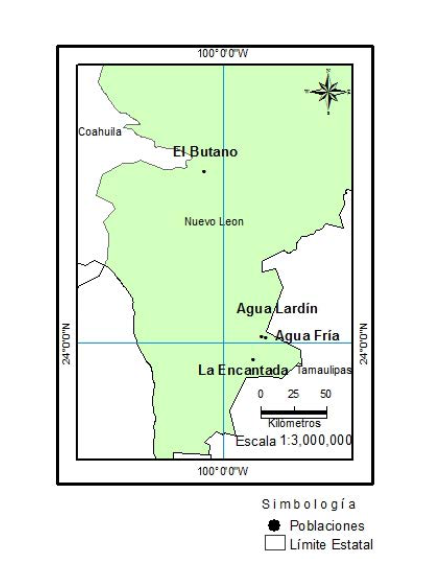
Four natural populations of Picea martinezii T. F. Patterson were evaluated for the purpose of determining the magnitude of variation to 19 anatomical and morphological characteristics of needles, cones and seeds among and within populations.The samples size was different for each population. The trees were selected throughout the stand, trying to be representative of the stand. For each one of the variables the normality was verified, was obtained the values of central tendency and dispersion. It was developed an analysis of variance and a variance components considering a mixed effects model. Were also performed multivariate analysis of principal components and canonical discriminant to characterize the populations. Analysis of variance showed statistically significant differences between populations in 14 of 19 variables. The five variables that showed no significant differences were the length side next to the resin ducts position, length of cone, width of the cone, wing length with seed and width of the seed wing. Principal component shows that the first three components explain 56% of the total variance. The comparison of means, the principal components and the Mahalanobis distance showed that La Encantada and Agua Lardín populations are more distant because their needles, cones and seeds characteristics, mainly the rows and number of stomata on the needles. The populations have two continuous resin ducts.
Downloads
Article Details

This work is licensed under a Creative Commons Attribution-NonCommercial 4.0 International License.
Those authors who have publications with this journal accept the following terms of the License Attribution-NonCommercial 4.0 International (CC BY-NC 4.0):
You are free to:
- Share — copy and redistribute the material in any medium or format
- Adapt — remix, transform, and build upon the material
The licensor cannot revoke these freedoms as long as you follow the license terms.
Under the following terms:
- Attribution — You must give appropriate credit, provide a link to the license, and indicate if changes were made. You may do so in any reasonable manner, but not in any way that suggests the licensor endorses you or your use.
- NonCommercial — You may not use the material for commercial purposes.
- No additional restrictions — You may not apply legal terms or technological measures that legally restrict others from doing anything the license permits.
The journal is not responsible for the opinions and concepts expressed in the works, they are the sole responsibility of the authors. The Editor, with the assistance of the Editorial Committee, reserves the right to suggest or request advisable or necessary modifications. They are accepted to publish original scientific papers, research results of interest that have not been published or sent to another journal for the same purpose.
The mention of trademarks of equipment, instruments or specific materials is for identification purposes, and there is no promotional commitment in relation to them, neither by the authors nor by the publisher.
How to Cite
References
BOX, G. E. P. y D. R. COX. An analysis of transformations. Journal of the Royal Statistical Society. Series B (methodological), 1964, vol. 26, no. 2, p. 211-252.
CONABIO. 2004. Mapa base del estado de Nuevo León. Escala 1: 2000000. México. [Archivo en línea en formato Vectoriales (Arcview)]. 8 de diciembre de 2008. Disponible en: http://www.conabio.gob.mx/informacion/cgi-bin/geo_metadatosftp_esp.cgi?Id=446& formato=d
CRONQUIST, A. Botánica básica. Traductor Marino A., Antonio. 2ª ed. Ed. Continental. México. 1986. 665 p.
FAVELA L., S. Aplicación de técnicas numéricas en algunos pinos mexicanos. Reporte científico Nº 25. Universidad Autónoma de Nuevo León. Facultad de Ciencias Forestales. Linares, N. L. 1991. 35 p.
HAIR, J. F.; R. E. Anderson; R. L. Tatham y W. C. Black. Análisis multivariante. 5ª ed. Ed. Prentice-Hall. Madrid, España. 1999. 799 p.
HERNÁNDEZ G., J. J. Variación morfológica de acículas, conos y semillas de Pinus chiapensis de Oaxaca y Chiapas. Tesis Profesional. Universidad Autónoma Chapingo. Chapingo, México.1986. 91 p.
HERNÁNDEZ S., D. Variación morfológica y anatómica de Picea mexicana Martínez en poblaciones naturales de México. Tesis Profesional. Universidad Autónoma Agraria Antonio Narro, Buenavista, Saltillo, Coahuila, México. 2009. 52 p.
HINES W. W. y D. C. MONTGOMERY. Probabilidad y estadística para ingeniería y administración. Traductor Nagore, G. 2ª ed. Ed. Continental. México. 1996. 834 p.
INFANTE G., S. y G. P. ZÁRATE DE L. Métodos estadísticos. 2ª ed. Ed. Trillas. México. 1990. 643 p.
JOHNSON, D. E. Métodos multivariados aplicados al análisis de datos. Primera edición en español. International Thomson Editores. México. 2000. 566 p.
LEDIG, F. T.; M. MÁPULA L.; B. BERMEJO V.; C. FLORES L.; V. REYES H., y M. A. CAPÓ A. Locations of endangered spruce populations in México and the demography of Picea chihuahuana. Madroño 2000, vol. 47, pp. 71-88.
LITTELL, C. R., G. A. MILLIKEN., W. W., STROUP y R.D. WOLFINGER. SAS® System For Mixed Models. SAS Institute Inc Cary, NC U. S. A. 1996. 633 p.
MÜLLER-USING, B. y S. VELÁZQUEZ F. Aportes a la distribución geográfica del pinabete de Chihuahua (Picea chihuahuana Martínez) en México: dos nuevos registros en el estado de Nuevo León. Inédito. 1983. 22 p.
PATTERSON, T. F. A new species of Picea (Pinaceae) from Nuevo León, México. SIDA, 1988, vol. 13, pp. 131-135.
PRIETO M., E. Variación morfológica de conos y semillas de 13 poblaciones naturales de Picea (Pinaceae) en México. Tesis profesional. Universidad Autónoma Chapingo. Chapingo. México. 1992. 73 p.
REYES H., V. J., J. J. VARGAS H., J. LÓPEZ U., y H. VAQUERA H. Variación morfológica y anatómica en poblaciones mexicanas de Pseudotsuga (Pinaceae). Acta Botánica Mexicana, 2005, vol. 70, p. 47-67.
SANTOS G., R. Variación morfológica y anatómica en hojas y conos de ocho localidades de Pseudotsuga en el Norte de México. Tesis profesional. Universidad Autónoma Agraria Antonio Narro. Buenavista, Saltillo, Coahuila, México. 1998. 60 p.
SAS INSTITUTE. SAS/STAT®User´s guide, release 6.03 Edition. SAS Institute, Inc. Cary, NC. USA. 1988. 1028 p.
SEMARNAT. 2003. Norma Oficial Mexicana NOM-059-SEMARNAT-2001, protección. ambiental-especies nativas de México de flora y fauna silvestres categorías de riesgo y especificaciones para su inclusión, exclusión o cambio-lista de especies en riesgo. Diario Oficial de la Federación. (D.O.F.) 23 de abril de 2003. México. 153 p. [En línea]. 20 de enero de 2009. Disponible en: http:// www.semarnat.gob.mx/gestionambiental /forestalysuelos /Pages/anuariosforestales.aspx
SIT, V. Analyzing ANOVA Designs. Biometrics Information Handbook 5. Research Branch, B. C. Ministry of Forests. Working Paper 07/1995. Victoria, B. C, Canadá. 1995. 61 p. SNEDECOR, W. G. y G. W. COCHRAN. Métodos estadísticos. Ed. Continental. México. 1981. 703 p.
TAYLOR, R, J., T. F. PATTERSON y R. J. HARROD. Systematics of Mexican Spruce- Revisited. Systematic Botany, 1994, vol. 19 no. 1, p. 47-59.
WENG, C. y S. T. JACKSON. Species differentiation of North American spruce (Picea) based on
morphological and anatomical characteristics of needles. Canadian Journal of Botany, 2000, vol. 78, no. 11, p. 1367-1383.
ZAR, J. H. Biostatistical Analysis. 2ª ed. Ed. Prentice-Hall. New Jersey U. S. A. 1984. 718 p.