Technological characterization of the marabout covered areas for energy uses by means of the SIG application
Article Sidebar
Main Article Content
Abstract
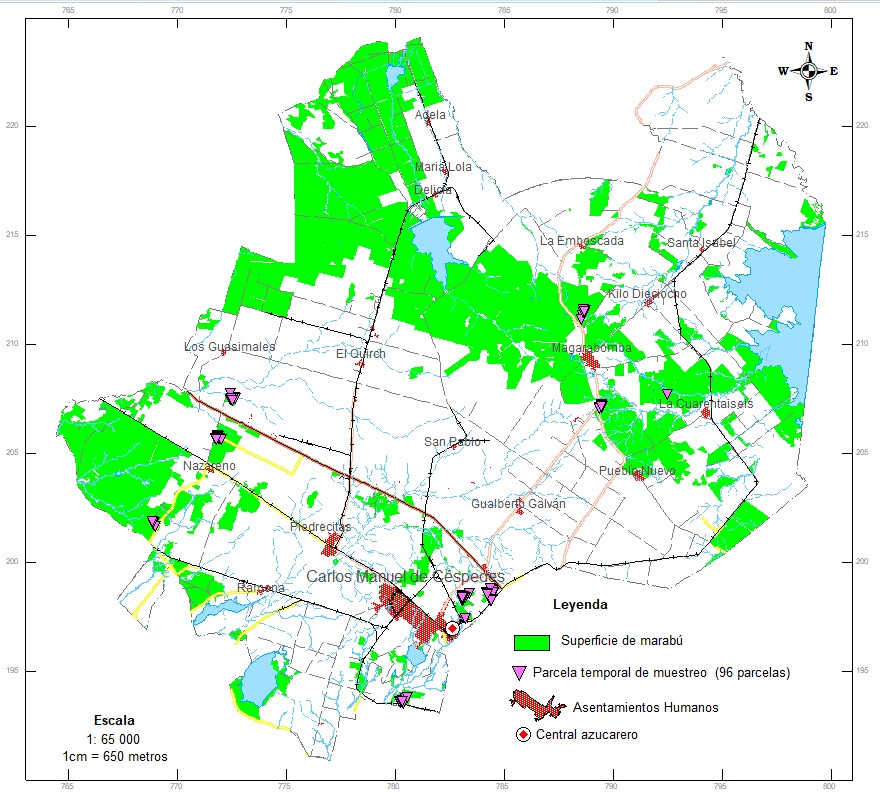
The use of Geographic Information Systems (GIS) is essential for characterizing plant formations intended for biomass production, as they allow for the efficient identification, monitoring, and management of forest resources, optimizing their sustainable use for clean energy generation and charcoal production. The study was carried out in the province of Camagüey, Cuba, with the objective of technologically characterizing the areas covered by Dychrostachys cinerea var. africana Brenan & Brummitt (marabou forest), in order to facilitate the inventory of its green aboveground biomass with bark for energy use. For this purpose, GIS based on digital platforms, managed using MapInfo software, were used, integrating maps of the effective area covered by the species, marabou forest categories, obstacles, slopes, land tenure, and technologies for its use. The results showed that the effective area covered by marabou was 15,662.14 hectares (23.58% of the total analyzed), distributed as follows: 59.77 hectares of fine marabou, 13,911.56 hectares of medium marabou, and 1,690.81 hectares of coarse marabou. These areas were located primarily on non-rocky, flat, agricultural soils, which allowed for the identification of sustainable and environmentally friendly technologies for their energy use. This study provides a methodological basis for the efficient management of marabou biomass in the region.
Downloads
Article Details

This work is licensed under a Creative Commons Attribution-NonCommercial 4.0 International License.
Those authors who have publications with this journal accept the following terms of the License Attribution-NonCommercial 4.0 International (CC BY-NC 4.0):
You are free to:
- Share — copy and redistribute the material in any medium or format
- Adapt — remix, transform, and build upon the material
The licensor cannot revoke these freedoms as long as you follow the license terms.
Under the following terms:
- Attribution — You must give appropriate credit, provide a link to the license, and indicate if changes were made. You may do so in any reasonable manner, but not in any way that suggests the licensor endorses you or your use.
- NonCommercial — You may not use the material for commercial purposes.
- No additional restrictions — You may not apply legal terms or technological measures that legally restrict others from doing anything the license permits.
The journal is not responsible for the opinions and concepts expressed in the works, they are the sole responsibility of the authors. The Editor, with the assistance of the Editorial Committee, reserves the right to suggest or request advisable or necessary modifications. They are accepted to publish original scientific papers, research results of interest that have not been published or sent to another journal for the same purpose.
The mention of trademarks of equipment, instruments or specific materials is for identification purposes, and there is no promotional commitment in relation to them, neither by the authors nor by the publisher.
How to Cite
References
Bravo, J. A., Vidal, A., Hernández, A., Peña, Y., Valle, L. M., Padrón, P. J., Padrón, P. R., & Paredes, L. (2015). Estimación de la biomasa aérea total verde con corteza de la vegetación de Dychrostachys cinerea var. Africana Brenan & Brummitt (Marabú). Memorias, 23.
Cano-Estrella, O., López-Sánchez, O., Guerrero-Posada, P., & San José-González, P. (2022). Evaluación de la calidad de triturado del marabú cortado con una cosechadora forestal. Revista Ingeniería Agrícola, 12(4). https://www.redalyc.org/journal/5862/586272874008/586272874008.pdf
García, J. M., Vidal, A., Herrero, J. A., & Bautista, E. (2012). Manual de Procedimiento para el aprovechamiento de impacto reducido de los bosques de Cuba. Proyecto “Desarrollo del Sector Forestal en Cuba”. La Habana. Dirección Forestal.
Herrero, J. A. (2003). Fajas forestales Hidrorreguladoras. Agroinfor.
SODePAZ. (2012). Aprovechamiento de la biomasa de marabú y otras especies energéticas como combustible en la generación de electricidad y recuperación ambiental en Camagüey. EUROPEAID.
Vidal, A., García, T., Bravo, J. A., Toirac, W., Hernández, A., Delgado, M., Álvarez, Y., Batista, F., Valle, M., Padrón, R., Paredes, L., & Risco, R. (2018). Metodología para la caracterización tecnológica e inventario de las áreas cubiertas de marabú con fines energéticos. Certificación de Registro del Senda: 2692 – 08 – 2028.