Greenhouse gas emissions balance of Cuba’s forestry sector
Article Sidebar
Main Article Content
Abstract
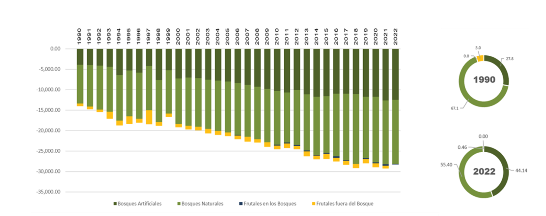
The Greenhouse Gas Inventory plays a key role in tracking GHG emissions at the global, regional, and local levels, as well as in verifying the success or failure of measures implemented for their mitigation. The objective of this work is to evaluate and present the results of the emissions and removals balance of the Cuban forestry sector for the period 1998-2022. The study was conducted using the gain-loss method for biomass for the category 'Forest land remaining forest land,' established in the IPCC Guidelines (2006). The information for the calculations is obtained from the annual reports of Forest Dynamics, the Agroforestry Group, and the Tropical Fruit Institute. National emission factors are used for the annual growth of aboveground biomass and for the carbon fraction in the wood. The results showed that natural forests, particularly seasonally wet forests and mangroves, were the main carbon sink. Artificial forests have increased their contribution. The net sink capacity has increased since 1990, due to the expansion of forested areas and a decrease in biomass extraction. However, absorptions began to stabilize after 2018, as the limit of available area for reforestation was approached. It was concluded that the Cuban forestry sector maintains a positive net carbon balance as a sink, although it is subject to variations from extreme weather events and to a future stabilization of removals.
Downloads
Article Details

This work is licensed under a Creative Commons Attribution-NonCommercial 4.0 International License.
Those authors who have publications with this journal accept the following terms of the License Attribution-NonCommercial 4.0 International (CC BY-NC 4.0):
You are free to:
- Share — copy and redistribute the material in any medium or format
- Adapt — remix, transform, and build upon the material
The licensor cannot revoke these freedoms as long as you follow the license terms.
Under the following terms:
- Attribution — You must give appropriate credit, provide a link to the license, and indicate if changes were made. You may do so in any reasonable manner, but not in any way that suggests the licensor endorses you or your use.
- NonCommercial — You may not use the material for commercial purposes.
- No additional restrictions — You may not apply legal terms or technological measures that legally restrict others from doing anything the license permits.
The journal is not responsible for the opinions and concepts expressed in the works, they are the sole responsibility of the authors. The Editor, with the assistance of the Editorial Committee, reserves the right to suggest or request advisable or necessary modifications. They are accepted to publish original scientific papers, research results of interest that have not been published or sent to another journal for the same purpose.
The mention of trademarks of equipment, instruments or specific materials is for identification purposes, and there is no promotional commitment in relation to them, neither by the authors nor by the publisher.
How to Cite
References
Álvarez, A & A. Mercadet. (2011). Libro: El Sector Forestal cubano y el cambio climático. Instituto de Investigaciones Agro-Forestales, Ministerio de la Agricultura, La Habana, Cuba. P 27. ISBN: 978-959-7215-00-4
Asturias, L. R. y Gil, L. A. (2023). Análisis de emisiones de CO2 en América Latina: una perspectiva de series temporales basada en la integración fraccionaria. National Library of Medicine (National Center for Biotechnology information). 30/9/2023; 30(50): 109585-109605. doi: http://doi.org/10.1007/s11356-023-29987-4
Datos macro (2023). Emisiones CO2 2023. http://datosmacro.expansion.com
Dirección Forestal. (2022). Dinámica Forestal.
Gabin, P. (2024). Balance de carbono: ¿Qué es? ¿Para qué sirve? http://liora.io
Hechavarría, L., Pérez Camacho, J., Cañizares Morera, M., & González Gutiérrez, P. A. (2023). Gestión de datos para actualizar la composición y abundancia de árboles en bosques cubanos. Serie Científica de la Universidad de Ciencias Informáticas, 16(1), 112-130. https://publicaciones.uci.cu/index.php/serie/article/view/1288
Instituto de Ecología y Cambio Climático (2018). Gases y compuestos de efecto invernadero. https://www.gob.mx
IPCC. (1996). Directrices del IPCC para los inventarios nacionales de gases de efecto invernadero-Versión revisada en 1996. Volumen 2: Cambio del uso de la tierra y silvicultura (J. T. Houghton, L. G. Meira Filho, B. Lim, K. Tréanton, I. Mamaty, Y. Bonduki, D. J. Griggs, & B. A. Callander, Eds.). IPCC WGI Technical Support Unit, Hadley Centre.
IPCC. (2003). Orientación del IPCC sobre las buenas prácticas y la gestión de la incertidumbre en los inventarios nacionales de gases de efecto invernadero. Organización Meteorológica Mundial.
IPCC. (2006). Directrices del IPCC del 2006 para los inventarios nacionales de GEI. Volumen 4: Agricultura, Silvicultura y otros usos de la tierra (S. Eggleston, L. Buendia, K. Miwa, T. Ngara, & K. Tanabe, Eds.). IGES.
IPCC (2022). Quinto Informe de evaluación del IPCC. Informe de síntesis. http://www.ipcc.ch/report/ar5/syr/. Publicado en Clima-ADAPTAR (nov. 2022).
Mercadet, A., Álvarez, A., Escarré, A., & Ortiz, O. (2005). El papel de los coeficientes de carbono de la madera en la certificación del efecto sumidero de los bosques cubanos. Memorias del Taller Internacional para el Desarrollo Forestal Sostenible DEFORS-2005.
Mercadet A., A. Álvarez, y A. Ajete. (2020) Libro: La mitigación del cambio climático y el Sector Forestal cubano. Instituto de Investigaciones Agro-Forestales. La Habana, Cuba. ISBN: 978-959-287-092-5 p16-18.
Valdés, A., Manso, R., Manrique, R., Carrillo, E., Sosa, C., López, C., León, A., Guevara, A. V., González, C., Boudet, D., Amárales, M., Biart, R., López, I., Pérez, D., Pire, S. F., Cuesta, L., Mercadet, A., & Álvarez, A. (2013). Emisiones y Remociones de Gases de Invernadero en Cuba. Reporte Actualizado para el Período 1990-2008. CITMA/AMA/Instituto de Meteorología.
Xilotl, M. y Serrano, P. (2025). Tierra, bosques y clima: desbloqueando la acción climática en América Latina y el Caribe. http://www.undp.org