Evaluation of dasometric and carbon removal in forest areas of the Guanahacabibes Agroforestry Enterprise
Article Sidebar
Main Article Content
Abstract
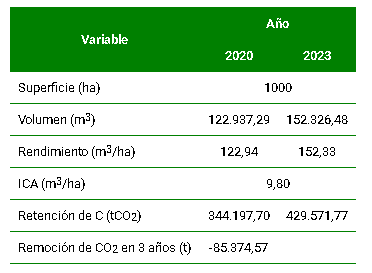
The capture of atmospheric carbon by forest ecosystems constitutes a key environmental service for climate change mitigation and biodiversity conservation. This study was conducted to evaluate the carbon balance and associated economic incentive in three forest areas (Bolondrón, La Fé, and La Base) of the Guanahacabibes Agroforestry Company in Cuba, during the years 2020 and 2023. Permanent sampling plots of 500 m² were randomly distributed, where the diameter at breast height and total height of the trees were measured to calculate timber volumes, and the SUMFOR v-5.02 system was applied to estimate CO₂ retention and net removal by stock difference. The results showed an initial total volume of 122,937.29 m³, which increased to 152,326.48 m³ in 2023, with a net removal of -85,374.57 tCO₂, confirming that the three areas function as carbon sinks. The Bolondrón natural forest exhibited the greatest annual increase (15.08 m³/ha/year) compared to the La Fé (1.14) and La Base (7.86) plantations. In conclusion, carbon sequestration generated a total economic incentive of $316,320.71 for environmental services, demonstrating the viability of this mechanism for promoting sustainable forest management in Cuba.
Downloads
Article Details

This work is licensed under a Creative Commons Attribution-NonCommercial 4.0 International License.
Those authors who have publications with this journal accept the following terms of the License Attribution-NonCommercial 4.0 International (CC BY-NC 4.0):
You are free to:
- Share — copy and redistribute the material in any medium or format
- Adapt — remix, transform, and build upon the material
The licensor cannot revoke these freedoms as long as you follow the license terms.
Under the following terms:
- Attribution — You must give appropriate credit, provide a link to the license, and indicate if changes were made. You may do so in any reasonable manner, but not in any way that suggests the licensor endorses you or your use.
- NonCommercial — You may not use the material for commercial purposes.
- No additional restrictions — You may not apply legal terms or technological measures that legally restrict others from doing anything the license permits.
The journal is not responsible for the opinions and concepts expressed in the works, they are the sole responsibility of the authors. The Editor, with the assistance of the Editorial Committee, reserves the right to suggest or request advisable or necessary modifications. They are accepted to publish original scientific papers, research results of interest that have not been published or sent to another journal for the same purpose.
The mention of trademarks of equipment, instruments or specific materials is for identification purposes, and there is no promotional commitment in relation to them, neither by the authors nor by the publisher.
How to Cite
References
Álvarez, A., Mercadet, A., Yero, L., Zulueta, I., Ortiz, O., Ajete, A. & Suárez, T. (2010). Formulación de estrategias de mitigación para Empresas Forestales. Subproy. 11.69.03: La mitigación del cambio climático por los bosques cubanos. Proy. 11.69: Segunda Comunicación Nacional de Cambio Climático, Subsector Forestal, Instituto de Investigaciones Forestales, La Habana. 54 p.
Álvarez, A., Gómez, C., Mercadet, A., Gómez, G., Casas, M., Collado, D., García, M., Legañoa G., Rodríguez, M., Díaz, G., Guzmán, A., Abella, P. & Vilamajó, D. (2020). Pago por Servicios Ambientales por Remoción de Carbono en Manejo Forestal Sostenible. Colección de Estudios de Casos “Experiencias en el enfrentamiento del Cambio Climático”. La Habana, Cuba, 12 pp. http://ccc.insmet.cu/cambioclimaticoencuba/sites/default/files/resultados/SERVICIOS%20AMBIENTALES%20CARBONO.pdf.
Álvarez, A., & Mercadet, A. (2024). Los Beneficios económicos y ambientales de la Biodiversidad Biológica en Cuba en apoyo a la toma de decisiones en sectores y paisajes productivos (ECOVALOR) Resultado II: Aplicadas y validadas metodologías para evaluar el estado de los bienes y servicios ecosistémicos en los sitios de intervención y las implicaciones económicas de su manejo en función de la toma de decisiones. Actualización del Sistema SUMFOR v.5.02. [Informe Final de Proyecto]
Asase, A., & Tetteh, D. A. (2016). Tree diversity, carbonstocks, and soil nutrients in cocoa-dominated andmixed food crops agroforestry systems compared tonatural forest in southeast Ghana. Agroecology and Sustainable Food Systems, 40(1), 96-113. https://doi.org/10.1080/21683565.2015.1110223.
Castro Blanco, E. & Castro Castell, Ana M. (2024). Evaluación del procedimiento para pago del servicio ecosistémico de remoción de CO2 atmosférico por los bosques. EN: Diplomado. Herramientas de gestión económica integral para la toma de decisiones asociada a servicios ecosistémicos. 43p.
Lok, S., Fraga, S., Noda, A., & García, M. (2013). Almacenamiento de carbono en el suelo de tres sistemasganaderos tropicales en explotación con ganado vacuno. Revista Cubana de Ciencia Agrícola, 47(1), 75-82. https://www.redalyc.org/pdf/1930/193028545014.pdf
Mercadet Portillo, A., Álvarez Brito, A. & Ajete Hernández, A. (2020). La Mitigación del Cambio Climático por el Sector Forestal Cubano. Instituto de Investigaciones Agro-Forestales. La Habana, Cuba. 187pp. ISBN: 978-959-287-092-5
MINAG (1982). Norma Ramal 595. Tratamientos silviculturales. Coníferas y Latifolias. Raleos en plantaciones y bosques naturales. 14 p.
MINAG (2024). Resolución 28/2024. Gaceta Oficial de la República de Cuba. Nº 18, pág. 325. http://www.gacetaoficial.gob.cu/
Olorunfemi, I. E., Komolafe, A. A., Fasinmirin, J. T. & Olufayo, A. A. (2019). Biomass carbon stocks of different land use management in the forest vegetative zone of Nigeria. Acta Oecologica, 95, 45-56. https://doi.org/10.1016/j.actao.2019.01.004
Peña Guerra, Y. (2022). Evaluación económica de alternativas de mitigación al Cambio Climático en la Empresa Agroforestal Matanzas. EN: Diplomado. Gestión Ambiental Territorial. 35p.
Planos Gutiérrez, E.O., & Gutiérrez Pérez, T.L. (2020). Tercera Comunicación Nacional a la Convención Marco de Naciones Unidas sobre Cambio Climático. Ministerio de Ciencia, Tecnología y Medio Ambiente. ISBN: 978-959-300-170-0.
Rügnitz, M. T, Chacón, M. L, & Porro, R. (2012). Guía para la determinación de carbono en pequeñas propiedades rurales (1ra ed.). World Agroforestry Centre (ICRAF). http://www.aecidcf.org.co/Ponencias/2016/septiembre/MI120916-1/Ref.7.Guia_Carbono.pdf