Proposal for the restoration of riparian vegetation in a section of the Cauto river in the municipality of Palma Soriano
Article Sidebar
Main Article Content
Abstract
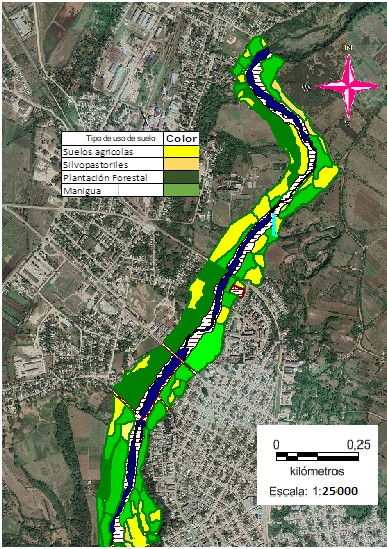
The restoration of riparian vegetation is crucial for recovering degraded ecosystems and maintaining the environmental services they provide. This study aimed to diagnose anthropogenic impacts on a stretch of the Cauto river in the Palma Soriano municipality and propose restoration strategies. A cartographic and floristic analysis was conducted between February and June 2021, using digital mapping techniques and vegetation sampling in three sub-reaches. The results showed that 40.6% of the area was deforested, with the greatest impact on the left bank due to high human activity. Eighteen plant species were identified, grouped into 12 families, with Mimosaceae being the most representative. The proposed restoration strategies included reforestation with native species, natural regeneration management, and control of invasive species such as marabou. It was concluded that active restoration is essential to recover vegetation cover and mitigate anthropogenic impacts on this riparian ecosystem.
Downloads
Article Details

This work is licensed under a Creative Commons Attribution-NonCommercial 4.0 International License.
Those authors who have publications with this journal accept the following terms of the License Attribution-NonCommercial 4.0 International (CC BY-NC 4.0):
You are free to:
- Share — copy and redistribute the material in any medium or format
- Adapt — remix, transform, and build upon the material
The licensor cannot revoke these freedoms as long as you follow the license terms.
Under the following terms:
- Attribution — You must give appropriate credit, provide a link to the license, and indicate if changes were made. You may do so in any reasonable manner, but not in any way that suggests the licensor endorses you or your use.
- NonCommercial — You may not use the material for commercial purposes.
- No additional restrictions — You may not apply legal terms or technological measures that legally restrict others from doing anything the license permits.
The journal is not responsible for the opinions and concepts expressed in the works, they are the sole responsibility of the authors. The Editor, with the assistance of the Editorial Committee, reserves the right to suggest or request advisable or necessary modifications. They are accepted to publish original scientific papers, research results of interest that have not been published or sent to another journal for the same purpose.
The mention of trademarks of equipment, instruments or specific materials is for identification purposes, and there is no promotional commitment in relation to them, neither by the authors nor by the publisher.
How to Cite
References
Beltrán, M. T., & Carmenates, Y. A. (2014). EVALUACIÓN DE LAS CONDICIONES AMBIENTALES DEL RÍO PONTEZUELO, MAYARÍ, HOLGUÍN. http://www.redciencia.cu/geobiblio/paper/2015_Torres_Pontezuelo%20GEO5-P8.pdf
Blanco, B. C., González, M. Á. C., Tenorio, M. C., Bombín, R. E., Anton, M. G., Fuster, M. G., Manzaneque, Á. G., Manzaneque, F. G., Saiz, J. M., & Juaristi, C. M. (1998). Los bosques ibéricos: Una interpretación geobotánica. Planeta.
Buitrago, L. (2013). Protocolo de Bioseguridad para el Manejo del Compost o Sustratos resultante de la transformación de los residuos de retamo espinoso (Ulex europaeus) y retamo liso (Genista monspessulana), para su incorporación a los procesos de propagación de material vegetal, bajo condiciones controladas. Bogotá: Jardín Botánico José Celestino Mutis.
Carreras, C. E. P. (2004). Reforestación Sucesional en la Sierra de Cubitas, Camagüey, Cuba.
Cowling, R. M., Rundel, P. W., Lamont, B. B., Arroyo, M. K., & Arianoutsou, M. (1996). Plant diversity in Mediterranean-climate regions. Trends in Ecology & Evolution, 11(9), 362-366.
Etchebarne, V. (2010). Calidad de agua y de la zona ribereña en sistemas lóticos de regiones ganaderas extensivas y lecheras de la cuenca del Río Santa Lucía.
Jiménez, L., Capa-Mora, D., Quichimbo, P., Mezquida, E. T., Benito Capa, M., & Rubio Sánchez, A. (2016). Influencia de las características ambientales en la composición florística de un bosque siempreverde piemontano. Bosques Latitud Cero, 6(2). https://oa.upm.es/id/eprint/48547
Rosso, J. J., & Cirelli, A. F. (2013). Effects of land use on environmental conditions and macrophytes in prairie lotic ecosystems. Limnologica, 43(1), 18-26.
Sirombra, M. G., & Mesa, L. M. (2010). Floristic composition and distribution of the Andean subtropical riparian forests of Lules River, Tucuman, Argentina. Revista de Biologia Tropical, 58(1), 499-510.
Teixeira de Mello, F. (2007). Efecto del uso del suelo sobre la calidad del agua y las comunidades de peces en sistemas lóticos de la cuenca baja del Río Santa Lucía (Uruguay).
Vargas-Fonseca, L. (2012). Análisis de una cronosecuencia de bosques tropicales del corredor biológico Osa, Costa Rica. https://agris.fao.org/search/en/providers/124451/records/66470d58e62948cba00accd3
Vitousek, P. M., Mooney, H. A., Lubchenco, J., & Melillo, J. M. (1997). Human Domination of Earth’s Ecosystems. Science, 277(5325), 494-499. https://doi.org/10.1126/science.277.5325.494