Production of edible mushrooms on wood and lignocellulosic substrates in Tercer Frente
Article Sidebar
Main Article Content
Abstract
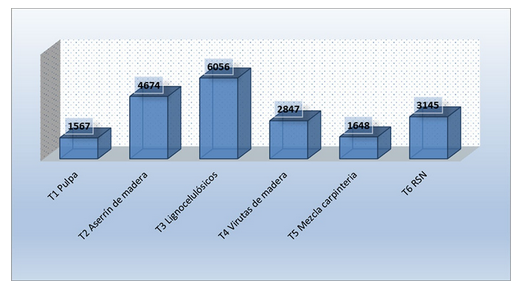
The search for nutritious and sustainable food alternatives is crucial to addressing global nutritional challenges, especially in developing countries. This study aimed to evaluate the yield of Pleurotus ostreatus cultivated on six substrates derived from agro-industrial and timber waste from the Tercer Frente municipality in Cuba. Substrates such as coffee pulp, sawdust, wood shavings, and lignocellulosic sesame residue were used. These substrates were pasteurized, inoculated with 5% inoculum, and placed in polyethylene bags under controlled temperature and humidity conditions. The main results showed that the lignocellulosic substrate (T3) obtained the highest final yield (30.3%) and biological efficiency (95%), while the coffee pulp (control) had the lowest yield (7.8%). It was concluded that the composition and physical properties of the substrate, especially the cellulose and lignin content and an appropriate particle size, significantly determine fungal development. Cultivation in these residues represents a productive and sustainable alternative that values local byproducts.
Downloads
Article Details

This work is licensed under a Creative Commons Attribution-NonCommercial 4.0 International License.
Those authors who have publications with this journal accept the following terms of the License Attribution-NonCommercial 4.0 International (CC BY-NC 4.0):
You are free to:
- Share — copy and redistribute the material in any medium or format
- Adapt — remix, transform, and build upon the material
The licensor cannot revoke these freedoms as long as you follow the license terms.
Under the following terms:
- Attribution — You must give appropriate credit, provide a link to the license, and indicate if changes were made. You may do so in any reasonable manner, but not in any way that suggests the licensor endorses you or your use.
- NonCommercial — You may not use the material for commercial purposes.
- No additional restrictions — You may not apply legal terms or technological measures that legally restrict others from doing anything the license permits.
The journal is not responsible for the opinions and concepts expressed in the works, they are the sole responsibility of the authors. The Editor, with the assistance of the Editorial Committee, reserves the right to suggest or request advisable or necessary modifications. They are accepted to publish original scientific papers, research results of interest that have not been published or sent to another journal for the same purpose.
The mention of trademarks of equipment, instruments or specific materials is for identification purposes, and there is no promotional commitment in relation to them, neither by the authors nor by the publisher.
How to Cite
References
Aguilar, A., Bustamante, I., & Flores, P. G. (2025). Determinación de la proteína y grasa de tres tipos de hongos comestibles: Champiñón (Agaricus bisporus), Pleurotus (Pleurotus ostreatus) y Shiitake (Lentinula edodes). https://repositorio.upeu.edu.pe/handle/20.500.12840/2566
Amazonical. (2024). ¿Son seguras y saludables las setas comestibles durante el embarazo?https://amazonical.com/blog/setas-y-embarazo
CLA. (2019). Cuadernos Latinoamericanos de Administración. Cuadernos Latinoamericanos de Administración, IV(6), 20.
Díaz Muñoz, K., Casanova Guajardo, M., León Torres, C. A., Gil Ramírez, L. A., Bardales Vásquez, C. B., & Cabos Sánchez, J. (2019). Producción de Pleurotus ostreatus (Pleurotaceae) ICFC 153/99 cultivado sobre diferentes residuos lignocelulósicos. Arnaldoa, 26(3), 56. https://doi.org/10.22497/arnaldoa.263.26322
Durón, R. (2012). Orígenes orgánicos. https://www.facebook.com/maternofetalmexico/posts
Fernández Uribe, Y. del S. (2014). Cultivo de orellas (Pleurotus ostreatus) en cinco sustratos generados en los procesos productivos agropecuarios, en dos épocas de siembra, en el municipio de Ituango [PhD Thesis]. Universidad Nacional Abierta y a Distancia, Escuela de Ciencias Agrícolas, Pecuarias y del Medio Ambiente.
Garzón, J. P., & Cuervo, J. L. (2008). Producción de Pleurotus ostreatus sobre residuos sólidos lignocelulósicos de diferente procedencia. Ciencias Biomédicas, 6(10), 101-236.
Guadalajara, F. (2025). Manual de cultivo de P. ostreatus en troncos. https://www.foromicologico.es
Hoffmann, R. R. (2019). Factors affecting mushroom Pleurotus spp. Saudi Journal of Biological Sciences, 26(4), 633-646. https://doi.org/10.1016/j.sjbs.2016.12.005
Infante, C., Cuadrado, B., de Arco, D., Perez, K., Barrera, E., & San Juan, M. (2016). Cultivo de hongos comestibles utilizando desechos agrícolas e industriales. Ciencia y Tecnología, 32(1), 31-46.
Ledoux-Ovies, T., Salermo-Martínez, M. L., Costales-Sotero, R., & Arcia Montes de Oca, J. (2021). Importancia de la recuperación de la planta de hongos comestibles del ICIDCA. ICIDCA sobre los derivados de la caña de azúcar, 55(3), 20-21.
Liao, H. L., Hsu, C. M., Hameed, K., & Cotter, D. I. Y. V. T. (2025). FunGuide: Grow Your Own Oyster Mushrooms at Home. http://edis.ifas.ufl.edu
López, A., Castillo, D., & Tito, C. (2025). Rendimiento del hongo comestible Pleurotus ostreatus cultivado en diferentes sustratos a base de residuos agroindustriales. Revista Ciencias Biológicas y Ambientales - RECIBYA, 2(1), 3-9. https://doi.org/10.33326/29585309.2023.1.2006
López R., I. (2023). Spent oyster mushroom substrate in a mix with organic soil for plant pot cultivation. Micología Aplicada Internacional, 20(1), 17-26.
Mata, G. (2025). Virutas de pino para cultivo de setas. Cultivo de Pleurotus ostreatus en viruta de pino: Obtención de cepas. https://www.scielo.org.mx
Mata, G., Gaitán-Hernández, R., & Salmones, D. (2016). La investigación en micología básica y aplicada: Aportes para un desarrollo sustentable. En D. Martínez-Carrera & J. Ramírez-Juárez (Eds.), Ciencia, tecnología e innovación en el sistema agroalimentario de México (pp. 695-719). Colegio de Postgraduados-AMC-CONACyT-UPAEP-IMINAP.
Mata, G., Pérez-Torres, J. A., Medel, R., Pérez-Merlo, R., & Salmones, D. (2019). Cultivo de Pleurotus ostreatus en viruta de pino: Obtención de cepas y evaluación de su productividad. Madera y Bosques, 25(2), 19. https://doi.org/10.21829/myb.2019.2521715
Mata, G., Salmones, D., & Savoie, J. M. (2017). Las enzimas lignocelulolíticas de Pleurotus spp. En J. E. Sánchez & D. J. Royse (Eds.), La biología, el cultivo y las propiedades nutricionales y medicinales de las setas Pleurotus spp (pp. 63-82). Ecosur.
Navarro, D., Ramajo, J., Verdecia, M., & Chacón, J. (2018). Producción agroecológica de setas comestibles con iluminación natural. Café cacao, 17(1), 62-67.
Obando, G. A., Vásquez García, A., Benavides Palacios, D. E., & Jojoa Martínez, H. F. (2022). Producción de hongo orellana (Pleurotus ostreatus) sobre residuos agrícolas y pastos generados en la comunidad de Obonuco, Nariño. Revista Colombiana de Investigaciones Agroindustriales, 9(2), 42-54. https://doi.org/10.23850/24220582.4865
OPS. (2006). Estrategia regional y plan de acción para un enfoque integrado sobre la prevención y el control de las enfermedades crónicas, incluyendo el régimen alimentario, la actividad física y la salud. Organización Panamericana de la Salud.
Porrata-Maury, C. (2020). Consumo y preferencias alimentarias de la población cubana con 15 y más años de edad. Revista Cubana de Alimentación y Nutrición, 19(1), 87-105.
Puig-Fernández, Y., Crespo-Zafra, L. M., Cardona-Soberao, Y. R., Matos-Mosqueda, L., & Serrano-Alberni, M. (2020). Evaluación de tres residuos agroindustriales como sustratos para cultivo del Pleurotus ostreatus Var. Florida. Revista Científica Multidisciplinaria Arbitrada YACHASUN, 4(7), 19. https://doi.org/10.46296/yc.v4i7.0040
Sales-Campos, C. (2009). Mineral composition of raw material, substrate and fruiting bodies of Pleurotus ostreatus in culture. Interciencia, 34(6), 432-436.
Sánchez, J. E., Andrade, R. H., & Moreno, L. (2017). La protección del sustrato para el cultivo de Pleurotus spp. Y otros hongos comestibles. En J. E. Sánchez & D. J. Royse (Eds.), La biología, el cultivo y las propiedades nutricionales y medicinales de las setas Pleurotus spp (pp. 107-126). Ecosur.
Sánchez, J. E., & Royse, D. J. (2017). La biología, el cultivo y las propiedades nutricionales y medicinales de las setas Pleurotus spp. El Colegio de la Frontera Sur.
ScienceDirect. (2025). Una comparación crítica de la pirólisis de celulosa, lignina y serín de pino. http://www.sciencedirect.com
Semarnat. (2016). Anuario Estadístico de la Producción Forestal 2015 (p. 57). Secretaría de Medio Ambiente y Recursos Naturales.
Sheng, Q. (2017). Producción comercial de la seta Pleurotus spp. En J. E. Sánchez & D. J. Royse (Eds.), La biología, el cultivo y las propiedades nutricionales y medicinales de las setas Pleurotus spp (pp. 127-148). Ecosur.
Tabares Navarro, C. M. (2025). Uso de dieta probiótica con setas comestibles en gestantes de la provincia Santiago de Cuba en el 2024 [Master’s Thesis]. Universidad de Ciencias Médicas.
Verdecia García, M. J. (2012). Tecnología para el Cultivo de setas comestibles Pleurotus ostreatus (p. 6). Estación Central de Investigaciones de Café y Cacao (ECICC).
Vico Plaza, J. (2024). El alimento de temporada que te ayudará a reducir el colesterol y a regular tu microbiota. https://www.vitonica.com/alimentos-funcionales/anade